SPECIAL RELATIVITY · GENERAL RELATIVITY · GRAVITY
Relativity and Gravity — Moving Standing Waves in Vibrating Space
With Albert Einstein as our guide: from Galileo, Newton, Huygens, Leibniz, Mach, Faraday, Maxwell, Lorentz, Poincaré and Minkowski to real Space, invariant e-sphere resonance, matter-centred time, de Broglie phase, equivalence and one physical cause of gravity.
Living working document for Human–AI collaboration and rigorous review · Geoffrey Haselhurst with AI collaborators · Revised 26 August 2026 · synchronised with the 25 August synthesis and Action 0.6
Orientation. Relativity is the measured geometry of matter, clocks and signals in motion. WSM keeps that brilliant geometry and changes its physical foundation: from matter particles moving in absolute Space and Time to the vibratory wave motion of Space causing matter and time. It proposes one infinite, eternal, continuous, nearly rigid and slightly elastic solid Space. Space does not flow bodily; enduring local elements oscillate and longitudinal waves propagate through them. Matter is recurrent organisation of that motion. A resting electron is an open spherical reclosure of waves arriving from every direction; a moving electron is the same living recurrence rebuilt directionally as a wave egg. Time is counted vibratory change, and its local direction relative to matter is physical: converging in-waves are future-forming, wave-centre reclosure is present, and continuing out-waves are past-carrying.
The exact spine is compact. An isotropic rest state has zero vector momentum, so translation requires directional wave asymmetry. Conditional on the reciprocal moving pair, one interference identity gives translation, the Lorentz axial scale, the de Broglie phase and the proper-time phase read along the centre. E-spheres also write forward and rear curvature onto crossing plane waves. Through neutral matter the large phase-odd displacement nearly cancels, while repeated writing and reclosure form a tiny, mass-weighted phase-even delay. That compact source propagates causally in the reduced longitudinal \(1/r\) Green class; its slope is inverse-square, its Hessian is tidal, and incoming-minus-outgoing stress changes the receiver’s momentum. The conditional exponential metric then records clock, ruler and path comparisons; it is a ledger of this proposed process, not another substance. Differences of longitudinal directional projectors already contain exact local \(+\) and \(\times\) quadratures.
Einstein’s equations are not the defeated theory on this page: they are the quantitative benchmark and Einstein is the guide. The tiers distinguish what is observed, exact under stated premises, structurally identified, proposed, or still to be calculated. Action 0.6 must now produce the autonomous finite e-sphere and its moving family, derive the reciprocal pair, normalize the phase-even source and \(G\), recover universal clock–ruler–signal response, close the healthy luminal tensor mode with the same \(G\), and solve finite strong-gravity objects. The page therefore offers a vivid physical explanation and a disciplined research programme without pretending that every coefficient has already been deduced.
One status compass, stated once. This page contains exact geometry, established observations, physical explanations and controlled mathematical reconstructions. Action 0.6 is the common dynamics from which the complete stable e-sphere, moving family, stress normalization, gravitational coupling and radiating modes are to be calculated. The A/B/C/D/Q tiers carry that status from here onward, allowing the physical argument to live and breathe without repetitive interruption.
One substance; no external edge or external clock. If Space is the only physical substance, no second substance can separate it, contain it or create it from outside. A physical gap would already require another kind of reality to carry separation or causal connection. WSM therefore begins with Space as continuous and without a terminal physical outside. Calling Space “created earlier” applies time—the order and measure of change within Space—to the existence of Space itself. Space is not an object waiting inside an external Time. It is the uncreated physical ground whose vibratory change gives matter its clocks and causal histories.
Solid does not mean ordinary Hookean ether. Space does not stream past matter. Its local elements oscillate; matter moves by recurrent reconstruction. The bare determinant carrier supports longitudinal compression without a primitive quadratic transverse spring. Diamond-like rigidity belongs to organised, multidirectional standing-wave overlap within a far more rigid non-flowing medium.
Three-dimensional Space: one active phase selector, one stability control, one retired comparison—and three appearances of \(\sqrt3/2\).
The active geometric selector is the phase-volume closure written above. A separate candidate quartic-overlap Derrick control compares two-gradient and four-gradient scaling; under its stated window \(2<d<4\), it conditionally leaves the integer \(d=3\). The older paired-kernel range branch used \(0<\alpha<2\) with \(\alpha=d-2\); it is retained as a historical comparison from the retired paired-coherence route, not as evidence for Action 0.6. Once \(d=3\) is selected, the full-wavelength unit cube and its circumscribed sphere give \(R/\lambda_0=\sqrt3/2\) exactly. Lifted half-angle holonomy and the six-step reciprocal transfer reproduce the same number in orientation and transfer ledgers. The three appearances are cross-locks to be joined by one solution, not three interchangeable meanings.
The cube–sphere picture survives intact. It is the visual statement that three orthogonal full-period plane-wave directions share one spherical Huygens closure. The rejected cube–simplex comparison used unequal edge-scale conventions; that failed comparison does not touch the cube enclosing-sphere geometry that grew from the real plane-wave construction.
The physical question. Coordinates can describe motion; they cannot be the thing that moves. A metric can record gravity; it cannot be the vibrating thing recorded. Einstein repeatedly returned to spatially extended matter, physically qualified Space and one unified structure. WSM follows those questions to the literal answer: real waves in real Space.
Results already in the bank — the technical argument does not begin at §40.
- §15: the stated phase closure gives \(R_d/\lambda_0=\sqrt d/2\); its phase-volume closure selects integer \(d=3\). A candidate quartic-overlap two-gradient/four-gradient Derrick control conditionally leaves the same integer; the old paired-kernel selector is archived. Cube–sphere geometry, lifted holonomy and six-step transfer then meet at \(\sqrt3/2\) in three distinct ledgers.
- §17–20: isotropic directional wave content has zero \(V_1\) momentum moment, so translation requires a directional motion dipole. Given the reciprocal moving pair, exact factorisation gives the Lorentz axial scale, de Broglie phase, \(v\), \(v_{\rm ph}=c_0^2/v\), rapidity composition and centre phase rate \(\omega_e/\gamma\).
- §25: the phase dipole translates the spherical carrier exactly, \(\Delta\mathbf x_c=-\mathbf a_\phi\). Displacement, wave-normal slope and stress are respectively the position, momentum and force reads.
- §28: one Space and one standing-wave matter make equivalence structurally natural. The one-action target is \(M^{\rm active}=M^{\rm passive}=M^{\rm inertial}\), with one rank-one phase-even residue proportional to total inertial wave energy.
- §29–31: neutral matter locally forms a compact phase-even delay while its much larger phase-odd response cancels. The ideal Abel write has \(\delta_{\rm micro}=1/2\); under symmetric source/receiver factorisation the electron target is \(g_{\rm src}^{\rm micro}\simeq2.44980\times10^{-22}\), explicitly a calibration for R4 rather than a derivation of \(G\). A remote quadratic correction to an already-decayed odd tail is too steep to lead; a localized reduced even coordinate with the ordinary \(1/r\) Green class gives inverse-square slope and inverse-cube tides.
- §33: the displayed exponential transfer branch passes the written first-post-Newtonian coefficient audit when \(a=0\); its next static \(g_{00}\) discriminator is the cubic source-map coefficient \(b\), with the isotropic Schwarzschild value matched at \(b=1/12\).
- §36–37: differences of longitudinal projectors give the exact local \(+\) and \(\times\) spin-weight-two geometry. A travelling gravity wave must be their healthy collective projection from the same luminal longitudinal carrier; the written exponential exterior supplies sharp strong-gravity discriminants.
Tier D frontier: the finite moving solution, common signal–ruler–clock response, normalized even source and \(G\), equivalence precision, radiating projection and finite strong-gravity states.
Einstein as our guide — principles, experience and the unfinished foundation
Einstein is the natural guide through relativity because he understood both its mathematical power and the provisional nature of its foundations. He did not confuse a successful formal system with final reality. He repeatedly returned to the same questions WSM asks: How are principles created? What gives a theory truth content? Why should physics seek fewer independent foundations? What is the physical reality of Space? How can particles disappear into finite, singularity-free structure? How can relativity and quantum theory become one theory?
“I hold it true that pure thought can grasp reality, as the ancients dreamed.”
Albert Einstein, On the Method of Theoretical Physics, Herbert Spencer Lecture, Oxford, 10 June 1933.“Physics constitutes a logical system of thought which is in a state of evolution, whose basis (principles) cannot be distilled, as it were, from experience by an inductive method, but can only be arrived at by free invention. The justification (truth content) of the system rests in the verification of the derived propositions by sense experiences. Evolution is proceeding in the direction of increasing simplicity of the logical basis (principles). We must always be ready to change these notions — that is to say, the axiomatic basis of physics — in order to do justice to perceived facts in the most perfect way logically.”
Albert Einstein, Physics and Reality (1936).This is the method of the page. Empirical facts judge the deductions, but they do not uniquely dictate the ontology. A logically perfect theory can map observations while beginning from concepts that are incomplete descriptions of what exists. The deeper test is whether one foundation explains the same observations with fewer independent substances and laws, gives real causal connection, and continues through quantum theory, cosmology, matter, life and mind.
“The development during the present century is characterized by two theoretical systems essentially independent of each other: the theory of relativity and the quantum theory. The two systems do not directly contradict each other; but they seem little adapted to fusion into one unified theory. For the time being we have to admit that we do not possess any general theoretical basis for physics which can be regarded as its logical foundation.”
Albert Einstein, 1940.Einstein’s role in this essay. He explains the evolution from Newtonian particles to Faraday–Maxwell fields, Lorentz transformations, relativity, physical Space and the demand for one singularity-free field theory. WSM does not diminish Einstein. It follows his reasoning one step further: the unified structure is not particles and fields in spacetime, but the wave motion of Space itself.
Prime epistemic rule — observation is not interpretation
Relativity became difficult to picture because observation, mathematics and ontology were often fused into one story. WSM separates them. A clock reading is observed. A Lorentz transformation is exact mathematics. Whether four-dimensional spacetime geometry is the final physical ontology is an interpretation. A metric fits gravitational observations. Whether metric geometry is fundamental or an effective record of deeper physical dynamics is an ontological question. Logic establishes what follows from stated premises; agreement with measurement corroborates their physical applicability and disagreement falsifies it. Agreement does not by itself prove that only one ontology can produce the observed relation.
| Habitually stated as fact | Observed fact | Exact mathematical relation | WSM physical deduction |
|---|---|---|---|
| Time itself slows. | Different physical clocks accumulate different readings. | Different proper times along different worldlines. | The universal e-sphere carrier remains resonant; motion and gravity change the complete de Broglie, transition and closure phase accumulated by a clock. |
| Space contracts. | A moving rod has a shorter longitudinal separation under the measurement procedure. | Lorentz contraction. | The moving matter structure is a real directionally shortened wave ellipsoid. |
| The physical speed of light is everywhere the same. | Every local inertial observer measures the same normalized \(c_0\). | Lorentz invariance of local signal measurement. | The directional carrier speed obeys \(c'/c_0=E_d/E_{d0}\). D One transported train–ruler–clock response preserves the measured ratio. |
| There is no absolute Space. | No closed ordinary inertial experiment reveals a Galilean ether wind. | Local Lorentz covariance. | All internal standing-wave standards transform together; the external CMB wave state nevertheless defines a distinguished cosmic frame. |
| Gravity is curved spacetime. | Clocks, signals and trajectories vary systematically around matter. | A curved metric and geodesic motion. | A derived effective metric may record how the real gravity-transfer state changes signals, material scales, clock phase and standing-wave closure. |
| Inertial and gravitational mass are mysteriously equal. | All tested bodies fall with extraordinary universality. | Equivalence principle. | One standing-wave matter structure governed by one law has one acceleration response. |
Method for this page. Keep every successful equation. Let Einstein state the historical problem in his own words. Ask what real wave process makes the relation true. State necessary consequences of one substance and one law absolutely; state only the unpaid quantitative kernels as open.
How opposite foundations can produce the same observations
Einstein–Minkowski relativity and WSM begin from almost opposite physical pictures yet converge on the same tested Lorentz relations. That is possible because the observations constrain relations among clocks, rulers, light signals, energy and momentum; they do not uniquely identify what clocks, rulers, light and matter are.
| Question | Einstein–Minkowski relativity | WSM |
|---|---|---|
| Fundamental reality | Events, fields and stress–energy represented in dynamical spacetime geometry. | One infinite active Space and its real longitudinal vibratory wave motion. |
| Space | No operationally privileged inertial frame is required by the local laws. | Space is the one absolute physical substance; local instruments are wave structures of it. |
| Time | Coordinate time depends on frame; each worldline carries its own proper time. | There is one real order of change and one invariant e-sphere resonance; clock readings differ through accumulated phase geometry. |
| Signal speed | Local invariant \(c\) is a foundational symmetry. | Physical directional propagation obeys \(c'/c_0=E_d/E_{d0}\); WSM seeks the common signal, ruler and clock response that yields local measured \(c_0\). |
| Matter | Particles or fields represented within spacetime. | Finite standing-wave e-spheres of Space. |
| Lorentz contraction | Relation between inertial measurements. | Real directional deformation of moving standing-wave matter. |
| Gravity | Dynamical metric geometry. | Changed wave state of Space, represented by the metric. |
| Equivalence | Foundational principle abstracted from universal free fall. | One-substance WSM makes a common inertial–gravitational response structurally necessary. Equality of coefficients, composition independence and experimental precision remain outputs of the coupled solution. |
The invariant-carrier closure branch. WSM proposes that a formed e-sphere remains locked to one invariant proper carrier \(f_e\), with \(f_e=f_0\) the one-substance target. Once that physical premise is imposed, resonance requires:
Here \(\lambda_{\rm cl}\) is the closure wavelength belonging to the invariant carrier, not yet the wavelength of either travelling component in the reciprocal-motion control. When the state of Space changes on this branch, \(c'\) and \(\lambda_{\rm cl}\) change in the same proportion. If \(T_e=1/f_e\), then the dimensionless number of closure wavelengths crossed in one carrier period is exactly:
If the one-substance lock \(f_e=f_0\) is selected, then \(\lambda_{{\rm cl},0}=c_0/f_e=\lambda_0\). The cycle identity is dimensionless; it must not be equated with the speed \(c_0\). It exposes the proposed cause: carrier speed, closure wavelength and period belong to one resonance. The full local constant-\(c_0\) experiment still requires the derived transition modulation, material ruler and receiver clock described in §22.
This is the general lesson for science: logic can map a chosen foundation to observations with perfect consistency while the foundation remains only one possible account of reality. WSM is preferred only if its one substance and one law also explain what relativity alone leaves separate — quantum discreteness, nonlocal connection, matter structure, cosmology, mathematics, empiricism, evolution and mind.
The historical convergence
Relativity did not appear from nothing in 1905. It was the convergence of a long struggle over motion, Space, waves, relation, clocks, fields and gravity. Einstein understood this evolution better than almost anyone and described it with extraordinary clarity. Each major thinker held part of the physical structure that WSM now joins.
Part I — The road to relativity, with Einstein as guide
1. Galileo — relativity of uniform motion
Galileo’s ship is the clean beginning. Below decks, fish swim, drops fall, insects fly and objects are tossed. If the ship moves uniformly, every enclosed process continues as before. No purely internal mechanical experiment distinguishes uniform motion from rest. Galileo established operational relativity before fields or spacetime entered the story.
“Shut yourself up with some friend in the main cabin below decks on some large ship.”
Galileo Galilei, Dialogue Concerning the Two Chief World Systems, Second Day (1632).What remained unanswered was physical: why do every clock, ruler, oscillator and trajectory transform together? WSM supplies the common cause. The cabin and everything in it are made of standing waves. Uniform motion is a stable wave state shared by the whole system. Internal comparisons cannot reveal motion through Space because the measuring structures and the processes measured have changed coherently.
WSM completion. Galileo’s principle is not evidence that Space is unreal. It is evidence that a uniformly moving system made from one wave substance transforms as a whole.
2. Newton — real Space, measured duration, particles and gravity
Newton gave mechanics its exact dynamical skeleton. He distinguished uniform motion from acceleration and rotation, introduced inertial mass, and showed that one inverse-square law governs falling bodies, planets and tides. He also distinguished the absolute physical ground from the relative measures made with bodies and clocks.
“Absolute Space, in its own nature, without regard to any thing external, remains always similar and immovable. Relative Space is some moveable dimension or measure of the absolute spaces; which our senses determine, by its position to bodies; and which is vulgarly taken for immovable space.
And so instead of absolute places and motions, we use relative ones; and that without any inconvenience in common affairs; but in Philosophical disquisitions, we ought to abstract from our senses, and consider things themselves, distinct from what are only sensible measures of them. For it may be that there is no body really at rest, to which the places and motions of others may be referred.
Absolute, True, and Mathematical Time, of itself, and from its own nature flows equably without regard to any thing external, and by another name is called Duration: Relative, Apparent, and Common Time is some sensible and external (whether accurate or unequable) measure of Duration by the means of motion, which is commonly used instead of True time; such as an Hour, a Day, a Month, a Year.
For the natural days are truly unequable, though they are commonly consider’d as equal, and used for a measure of time: Astronomers correct this inequality for their more accurate deducing of the celestial motions. It may be, that there is no such thing as an equable motion, whereby time may be accurately measured. All motions may be accelerated and retarded, but the True, or equable progress, of Absolute time is liable to no change. The duration or perseverance of the existence of things remains the same, whether the motions are swift or slow, or none at all.”
Isaac Newton, Principia, Scholium to the Definitions (1687).WSM keeps Newton’s insistence that physics needs a real ground, but changes the metaphysics. Space is the physical substance; time is not another entity flowing beside it. Vibratory motion supplies succession, repetition supplies duration and recurrent matter supplies physical clocks. Relative lengths and clock readings are measures made by wave structures whose geometry and accumulated phase can change. Space itself was not “created earlier”: earlier and later are relations among changes occurring within Space.
“The first attempt to lay a uniform theoretical foundation was the work of Newton. In his system everything is reduced to the following concepts:
i) Mass points with invariable mass
ii) Instant action-at-a-distance between any pair of mass points
iii) Law of motion for the mass point.
Physical events, in Newton’s view, are to be regarded as the motions, governed by fixed laws, of material points in space. This theoretical scheme is in essence an atomistic and mechanistic one. There was not, strictly speaking, any all-embracing foundation, because an explicit law was only formulated for the actions-at-a-distance of gravitation; while for other actions-at-a-distance nothing was established a priori except the law of equality of actio and reactio. Moreover, Newton himself fully realized that time and space were essential elements, as physically effective factors, of his system.”
Albert Einstein, 1940.“Newton’s endeavours to represent his system as necessarily conditioned by experience and to introduce the smallest possible number of concepts not directly referable to empirical objects is everywhere evident; in spite of this he set up the concept of absolute space and absolute time. For this he has often been criticized in recent years.
Therefore, in addition to masses and temporally variable distances, there must be something else that determines motion. That something he takes to be relation to absolute space. He is aware that space must possess a kind of physical reality if his laws of motion are to have any meaning, a reality of the same sort as material points and their distances.”
Albert Einstein, “Relativity and the Problem of Space,” Appendix V to Relativity: The Special and the General Theory, fifteenth edition (1952).Newton’s unresolved split was matter as separate particles placed in Space. That required action across a void. He recognised the absurdity himself.
“It is inconceivable that inanimate brute matter should, without mediation of something else which is not matter, operate on and affect other matter without mutual contact. That gravity should be innate, inherent and essential to matter, so that one body may act upon another at-a-distance, through a vacuum, without the mediation of anything else by and through which their action may be conveyed from one to another, is to me so great an absurdity that I believe no man, who has in philosophical matters a competent faculty of thinking, can ever fall into it.”
Isaac Newton, third letter to Richard Bentley, 25 February 1692/93.“So far I have explained the phenomena by the force of gravity, but I have not yet ascertained the cause of gravity itself; and I do not arbitrarily invent hypotheses.”
Isaac Newton, General Scholium added to the second edition of the Principia (1713).WSM keeps Newton’s real Space, duration and exact dynamics but removes the independent particles. Matter is Space in standing-wave form. Gravity is changed wave condition carried through the same Space. Newton’s absolute foundation and Einstein’s relative measurements can then both be true.
3. Huygens — wave propagation and reconstruction
Huygens supplied the causal picture that particle mechanics lacked. A later wavefront is reconstructed from the coordinated contribution of the earlier front. Reflection, refraction, diffraction and finite propagation follow from the geometry and speed of real waves.
“It is true that Newton tried to reduce light to the motion of material points in his corpuscular theory of light. Later on, however, as the phenomena of finite velocity, polarization, diffraction, and interference of light forced upon this theory more and more unnatural modifications, Huygens’ undulatory wave theory of light prevailed.”
Albert Einstein, 1936.WSM applies Huygens’ logic to matter itself. An e-sphere is not a permanent pellet carrying identity through empty space. It is continuously reconstructed by real waves arriving from all directions. Its centre is the stable phase closure of the whole spherical relation. Motion, inertia and gravity must therefore be transformations of the directional in-wave structure.
Huygens made wave matter thinkable. Once stable objects are ongoing reconstructions, Lorentz contraction, Machian support and gravitational response become aspects of one connected process.
4. Leibniz — relation, continuity and sufficient reason
Leibniz rejected an empty container independent of all relation and described space as an order of coexistence, time as an order of succession. He also demanded sufficient reason: nature cannot choose arbitrarily between physically indistinguishable duplicate worlds.
“I hold space to be something merely relative, as time is.”
G. W. Leibniz, correspondence with Samuel Clarke (1715–1716).Newton and Leibniz each held half the truth. Newton was right that acceleration and rotation require a real physical ground. Leibniz was right that measured distances and times are relations among actual states of reality, not empty things existing by themselves. WSM unites them: Space is the real substance, while every distance, phase and motion is a relation within its one continuous wave state.
5. Mach — inertia and the universe
Mach attacked the idea that inertia could be explained by motion relative to an empty container. He sought its origin in relation to the mass distribution of the universe. His insight was structural but lacked a real carrier.
“Mach, in the nineteenth century, was the only one who thought seriously of the elimination of the concept of space, in that he sought to replace it by the notion of the totality of the instantaneous distances between all material points. He made this attempt in order to arrive at a satisfactory understanding of inertia.”
Albert Einstein, “Relativity and the Problem of Space,” Appendix V to Relativity: The Special and the General Theory, fifteenth edition (1952).WSM supplies the carrier without eliminating Space. Every e-sphere is sustained by incoming waves from the surrounding matter-filled Space. Acceleration changes its relation to that global support. Inertia is local in the deformation and cosmological in the wave network that makes the stable e-sphere possible.
Machian content of WSM. A body does not first exist and then interact with the universe. Its stable existence is already a reciprocal wave relation with the universe.
6. Faraday — interaction becomes a physical state of Space
Faraday replaced invisible action between separated particles with a state of the intervening region. His lines of force restored continuity and made interaction something that could be represented throughout Space. WSM keeps that causal insight while changing the ontology beneath the representation.
“The greatest change in the axiomatic basis of physics — in other words, of our conception of the structure of reality — since Newton laid the foundation of theoretical physics was brought about by Faraday’s and Maxwell’s work on electromagnetic field phenomena.”
Albert Einstein, 1931.“Faraday must have grasped with unerring instinct the artificial nature of all attempts to refer electromagnetic phenomena to actions-at-a-distance between electric particles reacting on each other. How was each single iron filing among a lot scattered on a piece of paper to know of the single electric particles running round in a nearby conductor?
All these electric particles together seemed to create in the surrounding space a condition which in turn produced a certain order in the filings. These spatial states, today called fields, would, he was convinced, furnish the clue to the mysterious electromagnetic interactions. He conceived these fields as states of mechanical stress in an elastically distended body. For at that time this was the only way one could conceive of states that were apparently continuously distributed in space. The peculiar type of mechanical interpretation of these fields remained in the background — a sort of placation of the scientific conscience in view of the mechanical tradition of Faraday’s time.”
Albert Einstein, 1940.Faraday’s spatial condition is real: Space itself is changed. WSM does not reify \(\mathbf E\) and \(\mathbf B\) as substances laid over Space. “Electric field” and “magnetic field” remain extraordinarily successful mathematical coordinates of interaction; their proposed physical referent is the directional, phase and rotational order of one underlying longitudinal wave state.
7. Maxwell — finite wave propagation and the unfinished nature of light
Maxwell joined Faraday’s spatial relations into equations in which electromagnetic change propagates with a characteristic wave speed equal to the speed of light. The conflict with Galilean mechanics became unavoidable: what do the waves propagate in, and why do matter and rulers share their relativistic behaviour? WSM’s answer is deliberately literal—the thing changing and carrying the change is Space itself.
“The precise formulation of the time-space laws of those fields was the work of Maxwell. Imagine his feelings when the differential equations he had formulated proved to him that the electromagnetic fields spread in the form of polarized waves and with the speed of light! To few men in the world has such an experience been vouchsafed.
Only after Hertz had demonstrated experimentally the existence of Maxwell’s electromagnetic waves did resistance to the new theory break down. And what was true for electrical action could not be denied for gravitation. Everywhere Newton’s actions-at-a-distance gave way to fields spreading with finite velocity.
At that thrilling moment he surely never guessed that the riddling nature of light, apparently so completely solved, would continue to baffle succeeding generations.”
Albert Einstein, “Considerations Concerning the Fundaments of Theoretical Physics,” Science, 24 May 1940.The nineteenth-century ether problem arose because matter and medium remained different things. WSM removes that split. What instruments call light is a transition modulation written into real travelling waves of Space; matter is stable standing-wave transformation of the same Space. Maxwell’s equations organize the observed optical relations, but WSM seeks their source–carrier–receiver reduction without adding an electromagnetic substance.
8. Michelson–Morley, FitzGerald and Lorentz — the moving electron becomes an ellipsoid
Michelson and Morley observed no ordinary Galilean fringe shift of the expected size. The observation was not “Space does not exist.” It was that a moving apparatus cannot be treated as rigid, unchanged matter travelling through a simple mechanical ether.
“At the turn of the century the theoretical physicists of all nations considered H. A. Lorentz as the leading mind among them, and rightly so. The physicists of our time are mostly not fully aware of the decisive part which H. A. Lorentz played in shaping the fundamental ideas in theoretical physics. The reason for this strange fact is that Lorentz’s basic ideas have become so much a part of them that they are hardly able to realize quite how daring these ideas have been and to what extent they have simplified the foundations of physics.
Then came H. A. Lorentz’s decisive simplification of the theory. He based his investigations with unfaltering consistency upon the following hypotheses: The seat of the electromagnetic field is the empty space. In it there are only one electric and one magnetic field vector. This field is generated by atomistic electric charges upon which the field in turn exerts ponderomotive forces. The only connection between the electromagnetic field and ponderable matter arises from the fact that elementary electric charges are rigidly attached to atomistic particles of matter. For the latter Newton’s law of motion holds.
Upon this simplified foundation Lorentz based a complete theory of all electromagnetic phenomena known at the time, including those of the electrodynamics of moving bodies. It is a work of such consistency, lucidity, and beauty as has only rarely been attained in an empirical science.”
Albert Einstein, “H. A. Lorentz, Creator and Personality,” message delivered at Leiden for the Lorentz centenary (1953).“Indeed one of the most important of our fundamental assumptions must be that the ether not only occupies all space between molecules, atoms, or electrons, but that it pervades all these particles. We shall add the hypothesis that, though the particles may move, the ether always remains at rest.
I cannot but regard the ether, which can be the seat of an electromagnetic field with its energy and its vibrations, as endowed with a certain degree of substantiality, however different it may be from all ordinary matter.”
H. A. Lorentz, The Theory of Electrons and Its Applications to the Phenomena of Light and Radiant Heat (lectures delivered at Columbia University, 1906; published 1909).FitzGerald and Lorentz proposed real contraction. Lorentz developed local time and the transformation factor:
“The simplest course is certainly to consider the electrons themselves as wholly immutable, as perfectly rigid spheres, with a constant uniformly distributed surface charge. But, unfortunately, it is at variance with our theorem. It is for this reason that I have examined what becomes of the theory, if the electrons themselves are considered as liable to the same changes of dimensions as the bodies in which they are contained. The explanation of Michelson’s experimental result admits, for moving bodies, only a contraction, determined by the coefficient in the direction of the line of motion. The electrons themselves become flattened ellipsoids.
This would enable us to predict that no experiment made with a terrestrial source of light will ever show us an influence of the Earth’s motion.
It is clear that, since the observer is unconscious of these changes, relying on his rod, he will not find the true shape of bodies. He will take for a sphere what really is an ellipsoid.
Attention must now be drawn to a remarkable reciprocity that has been pointed out by Albert Einstein. Let us now imagine that each observer is able to see the system to which the other belongs. It will be clear by what has been said that the impressions received by the two observers would be alike in all respects. It would be impossible to tell which of them moves or stands still with respect to the ether. This is a point which Albert Einstein has laid particular stress on, in a theory in which he starts from what he calls the principle of relativity.
I cannot speak here of the many highly interesting applications which Albert Einstein has made of this principle. His results concerning electromagnetic and optical phenomena agree in the main with those which we have obtained, the chief difference being that Albert Einstein simply postulates what we have deduced from the fundamental equations of the electromagnetic field. By doing so, he may certainly take credit for making us see in the negative result of experiments like those of Michelson, Rayleigh and Brace, not a fortuitous compensation of opposing effects, but the manifestation of a general and fundamental principle.
Yet, I think, something may also be claimed in favour of the form in which I have presented the theory.”
H. A. Lorentz, The Theory of Electrons and Its Applications to the Phenomena of Light and Radiant Heat (lectures delivered at Columbia University, 1906; published 1909).Lorentz found the physical deformation but retained two ontological layers: an ether and particles moving within it. Einstein retained the transformation and removed the operational ether. WSM takes the third step: retain real Space, remove the independent particle. Matter is the moving wave deformation of Space itself.
Lorentz to WSM. “He will take for a sphere what really is an ellipsoid” is the visual centre of WSM relativity. The observer’s ruler changes because the observer and ruler are made of the same ellipsoidal standing waves.
9. Poincaré — relativity, synchronisation and group structure
Poincaré recognised the relativity principle, analysed clock synchronisation by light signals and identified the Lorentz transformations as a group. This was a decisive mathematical unification: the transformations were not isolated corrections but one closed symmetry structure.
WSM accepts the group exactly and asks for its physical generator. The Lorentz group is the symmetry of measurements made by stable moving standing-wave matter. Poincaré identified the structure; the moving e-sphere must supply the cause.
10. Einstein I — operational relativity and locally invariant light speed
Einstein’s great move was to treat clocks, rulers, synchronisation and light as one operational system. He did not attempt to retain an unchanged Newtonian observer while modifying only the light. Every inertial frame must formulate the laws in the same way.
“If, relative to K, K′ is a uniformly moving co-ordinate system devoid of rotation, then natural phenomena run their course with respect to K′ according to exactly the same general laws as with respect to K. This statement is called the principle of relativity.”
Albert Einstein, Relativity: The Special and the General Theory, Part I (English edition, 1954).“The second principle, on which the special theory of relativity rests, is the ‘principle of constant velocity of light in vacuo.’ This principle asserts that light in vacuo always has a definite velocity of propagation, independent of the state of motion of the observer or of the source of the light. The confidence which physicists place in this principle springs from the successes achieved by the electrodynamics of Maxwell and Lorentz.”
Albert Einstein, Relativity: The Special and the General Theory, Part I (English edition, 1954).Einstein’s postulates give the exact operational limit WSM must reproduce. WSM changes the physical reading: the locally measured \(c_0\) is invariant, while the underlying directional propagation obeys \(c'/c_0=E_d/E_{d0}\) and its wavelength changes around a moving e-sphere whose proper carrier remains invariant.
“The heuristic method of the special theory of relativity is characterized by the following principle: only those equations are admissible as an expression of natural laws which do not change their form when the co-ordinates are changed by means of the Lorentz transformation. This method led to the discovery of the necessary connection between momentum and energy, between electric and magnetic field strength, electrostatic and electrodynamic forces, inert mass and energy; thus the number of independent concepts and fundamental equations was reduced.”
Albert Einstein, 1934.WSM accepts the reduction and seeks the still deeper compression: one substance, one invariant resonance and one law beneath all those Lorentz-covariant relations.
11. Einstein II — equivalence, acceleration and general relativity
Einstein recognised that gravity could not remain a force added to special relativity. The equality of inertial and gravitational response revealed one deeper structure.
General relativity promoted equivalence into geometry. In GR the successful “gravitational field” is encoded in the geometry relating clocks, rods, free bodies and light rather than as a Newtonian force attached to one special kind of matter. WSM retains that geometry as an exact comparison map and proposes its physical referent: all of those clocks, rods, bodies and signals are standing-wave or travelling-wave states of the same Space, responding to changed wave relations within it.
This distinction is central. Relativity itself permits coordinate-dependent light propagation in a gravitational field while preserving the invariant local measurement. WSM makes the physical statement explicit: the directional ratio \(c'/c_0\) follows \(E_d/E_{d0}\); \(c_0\) is the calm-background normalization recovered by the completed local signal–ruler–clock comparison.
12. Einstein III — spatially extended matter, physical Space and unfinished unity
Einstein rejected the point particle as fundamental and repeatedly approached the WSM picture of matter as a finite high-energy region of a continuous physical reality.
“Space-time is not necessarily something to which one can ascribe a separate existence, independently of the actual objects of physical reality. Physical objects are not in space, but these objects are spatially extended. In this way the concept ‘empty space’ loses its meaning.”
Albert Einstein, “Note to the Fifteenth Edition,” dated 9 June 1952, Relativity: The Special and the General Theory.“The physical reality of space is represented by a field whose components are continuous functions of four independent variables — the co-ordinates of space and time. Since the theory of general relativity implies the representation of physical reality by a continuous field, the concept of particles or material points cannot play a fundamental part, nor can the concept of motion. The particle can only appear as a limited region in space in which the field strength or the energy density are particularly high.”
Albert Einstein, “On the Generalized Theory of Gravitation” (1950).Einstein has identified the spatial extension and high-energy centre. WSM replaces the irreducible field with the more economical physical process: the centre is the high-density closure of a finite spherical standing wave of Space.
“Recapitulating, we may say that according to the general theory of relativity space is endowed with physical qualities; in this sense, therefore, there exists an ether. According to the general theory of relativity space without ether is unthinkable; for in such space there not only would be no propagation of light, but also no possibility of existence for standards of space and time — measuring-rods and clocks — nor therefore any space-time intervals in the physical sense. But this ether may not be thought of as endowed with the quality characteristic of ponderable media, as consisting of parts which may be tracked through time. The idea of motion may not be applied to it.”
Albert Einstein, Leiden lecture, Ether and the Theory of Relativity (1920).Einstein removed the mechanical ether made of trackable particles; he did not reduce Space to nothing. WSM agrees that Space has no independent pieces that drift like matter. It adds that continuous Space can nevertheless possess motion of itself: real waves. The substance does not travel as a body; disturbances, phase and energy propagate through it.
“The inadequacy of this point of view manifested itself in the necessity of assuming finite dimensions for the particles in order to prevent the electromagnetic field existing at the surfaces from becoming infinitely large. The Maxwell equations in their original form do not, however, allow such a description of particles, because their corresponding solutions contain a singularity. Theoretical physicists have tried for a long time, therefore, to reach the goal by a modification of Maxwell’s equations. These attempts have, however, not been crowned with success.
What appears certain to me, however, is that, in the foundations of any consistent field theory the particle concept must not appear in addition to the field concept. The whole theory must be based solely on partial differential equations and their singularity-free solutions.”
Albert Einstein, 1936.Einstein’s specification, WSM’s task. Finite spatial matter, no independent particle, partial differential equations, singularity-free solutions, physically qualified Space and one unified structure. The e-sphere is WSM’s candidate answer.
13. Minkowski — spacetime as the invariant map
Minkowski gave the Lorentz relations their natural invariant geometry:
“Henceforth space by itself, and time by itself, are doomed to fade away into mere shadows, and only a kind of union of the two will preserve an independent reality.”
Hermann Minkowski, Space and Time (1908).“The inseparability of time and space emerged in connection with electrodynamics, or the law of propagation of light. With the discovery of the relativity of simultaneity, space and time were merged in a single continuum in a way similar to that in which the three dimensions of space had previously merged into a single continuum. Physical space was thus extended to a four dimensional space which also included the dimension of time. The four dimensional space of the special theory of relativity is just as rigid and absolute as Newton’s space.”
Albert Einstein, “The Problem of Space, Ether, and the Field in Physics” (1934), reprinted in Ideas and Opinions (1954), pp. 281–282.Einstein’s own description is exact: special-relativistic four-space is rigid and absolute—the invariant map. WSM retains that map and supplies the moving physical substance it records: real three-dimensional Space changing as waves.
The geometry is exact and indispensable. WSM changes what it means. Spacetime is the invariant map made from readings of clocks and rulers whose wave geometry changes with motion and gravity. It is not a second four-dimensional substance replacing real three-dimensional Space. Time is the measured order and amount of wave change; the fourth coordinate records that change alongside position.
“The non-mathematician is seized by a mysterious shuddering when he hears of ‘four-dimensional’ things, by a feeling not unlike that awakened by thoughts of the occult. And yet there is no more common-place statement than that the world in which we live is a four-dimensional space-time continuum. Space is a three-dimensional continuum. Similarly, the world of physical phenomena is naturally four dimensional in the space-time sense. For it is composed of individual events, each of which is described by four numbers, namely, three space co-ordinates x, y, z, and the time co-ordinate t.”
Albert Einstein, Relativity: The Special and the General Theory (English edition, 1954).Einstein’s statement is a description of events. WSM keeps the four-number description while locating the event in three-dimensional Space undergoing real wave motion.
Part II — WSM special relativity: constant resonance, changing geometry
14. The foundation — one substance, one law
WSM begins before relativity with the ontology the operational equations do not specify:
Space is the substance. Real longitudinal displacement is its vibratory motion. Matter is finite recurrent organisation of that same motion. \(c'\) is the physical directional propagation speed relative to Space; \(c_0\) is its calm-background normalization and the value returned when a local signal, material ruler and transition clock are compared.
Action 0.6 begins with one material displacement map and nothing beside it:
Within the explicitly restricted determinant-only class, the One Law and the declared identification \(E_d=W/J\) select the displayed volume energy. Filtered Huygens amplitudes \(\Xi=\mathcal W[X]\), compression-derived texture \(\Gamma=\mathcal G[J]\), the continuous polar lift \(Q\), light-train screens and recurrence coordinates are constrained views or histories of the same \(X\). They are not extra substances independently attached to Space.
Writing \(X=\mathbf a+\mathbf u\), the linear irrotational reduction may use \(\mathbf u=\nabla\Phi\). With periodic or decaying boundaries, the quadratic carrier is
The longitudinal sector therefore carries the ordinary luminal pole. The determinant carrier has constant impedance and no primitive quadratic transverse spring. Rigidity of organised matter is instead sought in chronological, noncommuting overlap of nonparallel longitudinal waves, beginning with the quartic sector.
Picture the physics before the symbols. The e-sphere is a finite, open standing-wave closure: waves arriving from all directions meet and continually remake its coherent centre. Around it, the much larger finite Huygens sphere or domain is not a shell but the coherence/return region through which the surrounding wave relation is assembled. Beyond every such finite domain lies infinite Space. Neither sphere is a container wall, membrane or edge of reality; both are organised wave relations inside the same continuous Space.
Language rule — never reify the ledger. On this page field, current, force, potential, metric, spacetime and tensor remain wherever their mathematics compresses real observations. Their physical referent is Space vibrating and the relations of that motion: a source or current records recurrent wave change, \(\mathbf F=d\mathbf p/dt\) records real wave-momentum transfer, \(g_{\mu\nu}\) records clock–ruler–path comparison, and tensor components organise directional moments. A ledger is a map of the motion—not another occupant of reality.

This is the exact plane-wave/spherical-wave bridge. Looking direction by direction, an e-sphere modifies every plane that passes through it. Looking at their coherent sum, the same changes are one spherical in-wave/out-wave relation. A common phase shift of the directional planes becomes a shifted spherical phase relation; it is not automatically dilution of energy. Energy density and later speed come from the physical action flux, while the geometry tells us how the planes reassemble.
Longitudinal means irrotational in the carrier reduction. Where \(\mathbf u=\nabla\Phi\) is regular, \(\nabla\times\mathbf u=0\). The \(4\pi\) hand, spherical rotation, photon helicity and tensor quadratures are ordered relations among longitudinal histories—not a second transverse material velocity or literal local vorticity of Space. Their faithful collective reductions are distinct physical questions and remain separately labelled.
One displacement, rich organisation. The determinant carrier gives compression and luminal longitudinal propagation. Nonparallel waves then create areas, volumes, phase order, recurrent centres and collective directional moments. “One substance” does not mean one undifferentiated wave; it means every stable form and every interaction must be an organisation of the same Space.
Compact real-wave glossary
| Term | Physical meaning on this page |
|---|---|
| Vibrating Space | The one continuous solid medium undergoing local oscillation and longitudinal wave propagation; it does not flow bodily. |
| Plane-wave sea | The all-direction background of real travelling longitudinal waves from which finite recurrences are assembled. |
| \(E_d\), \(c'\) | Directional wave-energy response and the corresponding local propagation speed in the One Law. |
| e-sphere / wave centre | The finite open electron recurrence and the present event at which its all-direction waves reclose; neither is a shell or particle. |
| Moving wave egg | The directionally unequal recurrence that translates by being rebuilt at neighbouring centres. |
| Huygens sphere | A finite coherence and boundary-condition domain inside infinite Space, not an outer edge of Space. |
| Light train | A finite travelling change written onto continuing real waves by a changing recurrent source. |
| Metric | A compressed ledger of comparisons among derived clocks, rulers and signal paths. |
| Quantity | Job on this page | Guardrail |
|---|---|---|
| \(E_d/E_{d0}\) | Dimensionless directional constitutive or characteristic response appearing in the One Law. | The Tier C gravity dictionary identifies the transfer response with \(N^2\); the receiver projection decides that bridge. It is distinct from the reduced hyperbolic factor \(\widehat W\), a Newtonian point potential or a second field. |
| \(\rho_E\) | Physical energy density calculated from the real action. | Do not identify it globally with \(E_d\) or \(|\Psi|^2\). |
| \(\widehat W=\cosh s,\;\widehat P=\sinh s\) | Conditional dimensionless reduced response and stress-like partner. | They are not the dimensional determinant energy \(W(J)\) of Action 0.6. |
| \(D_\pm=\widehat W\pm\widehat P=e^{\pm s}\) | Reciprocal factors on one transparent reduced branch. | The One Law alone does not make them physical writing speeds or Doppler factors; the coupled solution supplies that map. |
| \(N,\;g_{ij}\) | Effective clock and ruler factors in a derived metric summary. | They are outputs of the gravity and measurement kernels, not new substances. |
| Speed | Visible wave meaning |
|---|---|
| \(c_0\) | Calm-background longitudinal characteristic speed and far-background causal cone of Action 0.6. |
| \(c'(\mathbf x,\hat n,t)\) | Local nonlinear directional characteristic speed supplied by the complete response \(E_d/E_{d0}\). |
| \(v_{\rm centre}\) | Translation speed of the whole closed e-sphere pattern. |
| \(v_{\rm curve}\) | Peak or envelope speed of a finite written curve; it need not equal either local \(c'\) or the causal front. |
| \(c_{\rm measured}\) | The ratio returned by a real signal, material ruler and transition clock after all three have transformed together. |
Corpus guardrail. WSM contains real longitudinal displacement waves in real three-dimensional Space and nothing beside that one substance. “Elastic solid Space” names that connected non-flowing reality; it does not insert an ordinary Hookean shear medium or a second fundamental transverse-wave branch. Vector, transverse, tensor, spin and metric descriptions are organised relations among longitudinal waves. Six longitudinal channels already construct the exact local \(V_0\oplus V_2\) frame and its two spin-weight-two quadratures; the constitution and chord return also activate \(V_4\) and higher nonlinear sectors. Action 0.6 now has a concrete task: select the healthy collective modes and their measured coefficients from this rich one-substance organisation.
Directional One-Law reading. In the isotropic branch \(c'/c_0=E_d/E_{d0}\) is the defining normalized relation. In an anisotropic living e-sphere, \(E_d\) means the derived directional characteristic response of the coupled wave state; it is not an arbitrary scalar painted onto a constant-coefficient equation.
Relativity is therefore not attached as a second physical substance or law. It is the geometry of a finite standing wave preserving carrier identity and phase reclosure while its directional speed, wavelength and shape change.
15. The e-sphere at rest — two phase premises and one living sphere
At rest relative to the local background Space, real plane waves arrive from every direction. Opposite components balance at the centre. Their ordered interference forms a finite spherical region of continuously renewed wave relation—not a material shell around an empty point.
Premise A — one RMS antipodal phase cycle
In \(d\) spatial dimensions, isotropic directions obey \(\langle\mu^2\rangle=1/d\). Requiring the root-mean-square phase difference across opposite points of the sphere to be one complete background cycle gives
This condition fixes the radius once the dimension is given. It is a phase-variance condition—the kind a quadratic wave action could plausibly select—and it does not need a cube.
Premise B — phase volume equals one headless circuit
The unoriented directional base is headless, \(\hat{\mathbf n}\sim-\hat{\mathbf n}\): one complete projective circuit has length \(\pi R_d\), not \(2\pi R_d\). Compare the number of background wavelength-volumes inside the sphere with the number of wavelengths along that circuit:
The ratio formula is valid from \(d=1\) onward. Since \(\Xi_1<1\), \(\Xi_2<1\), \(\Xi_3=1\), \(\Xi_4>1\), and each same-parity sequence then increases, Premise B selects \(d=3\) among all positive integer dimensions. Together, A and B give
\(\mathcal G_{\rm geo}\) is the exact dimensionless geometric count formerly labelled \(E_{\rm geo}^{(\rm GH)}\); the \(E\) notation is retired here because this quantity is not physical energy. A half-wavelength nodal cell does not close the same phase relation: it gives \(\Delta\phi_{\rm rms}=\pi\) and \(\Xi_3=1/4\). The complete phase-repeat wavelength is therefore load-bearing.

WSM’s e-sphere–Space connection. Matter is not a separate particle inserted into an independent background entity. The same real wave medium that extends without boundary through infinite Space also forms the finite e-sphere, and the same wavelength counts across and through its closure. Geometry fixes the target relation; the Tier D finite solution stabilizes the regular open mode there.
| Ledger | Exact result | Limit or next physical connection |
|---|---|---|
| Phase scale | Premise A gives \(R_d/\lambda_0=\sqrt d/2\). | It does not select \(d\) by itself. |
| Dimension | Premise B gives \(\Xi_d=1\) only at integer \(d=3\). | Its projective volume–circuit equality remains a stated physical premise. |
| Longitudinal holonomy | \(1-\epsilon^2=1/4\) gives \(\epsilon=\sqrt3/2\) and a \(4\pi\) orientation return. | \(\epsilon\) is an orientation coordinate, not automatically the radius or speed. |
| Six-step transfer | \(\cosh s=2\) gives \(\tanh s=\sqrt3/2\). | \(s\) is a rapidity-like transfer coordinate, not automatically translational rapidity. |
The repeated \(\sqrt3/2\) is a striking compatibility target. The page will not count algebraically related appearances as independent proofs. One stable solution must decide whether radius, orientation and transfer are genuinely coordinates of the same e-sphere.
Keep four phase ledgers separate. The selected exterior carrier coordinate is \(b_0=k_0R=\pi\sqrt3\). The synchronized writing diagnostic is \(b_{\rm write}=\pi\sqrt3/2\); \(b_\pi=\pi\) is a separate Bessel/nodal diagnostic; and the physical observable is the complete exit relation \(\Phi_{\rm exit}(p)\) versus impact parameter. The exact theorem below belongs to the ideal straight-chord hemispherical screen. A variable radial \(E_d(r)\) realizes the same living closure through bent characteristics, diffraction or directional coupling. Thus \(2c_0\) is an exact effective control speed; the nonlinear e-sphere determines the local ray-speed profile.
Exact hemisphere–speed theorem. Let \[ q(r)=1-\frac{c_0}{c'(r)},\qquad \zeta(b)=2\int_b^R q(r)\frac{r\,dr}{\sqrt{r^2-b^2}}. \] If every straight chord leaves with the exact forward half-sphere \[ \zeta_F(b)=\sqrt{R^2-b^2}, \] Abel uniqueness gives \(q(r)=1/2\), hence \[ \boxed{c'_{\rm eff,F}=2c_0}. \] The exact mirror \(\zeta_R=-\sqrt{R^2-b^2}\) gives \(q=-1/2\) and \[ \boxed{c'_{\rm eff,R}=\frac23c_0}. \] The pair is reciprocal in slowness, \(c_0/c'=1/2,3/2\), not arithmetic speeds \(c_0\pm\Delta c\). This is the rigorous wave logic behind the one-radius advance or delay across a diameter.
From a resting sphere to a moving half-egg. The hemisphere is the exact uniform-sphere control, not a picture that must remain spherical when the source moves. For a plane wave travelling along \(\hat{\mathbf n}\), the physical screen written across that real plane front is the ray transform \[ q=1-\frac{c_0}{c'}, \qquad \zeta_{\hat{\mathbf n}}(\mathbf b,t) =\int_{\mathrm{ray}(\mathbf b,\hat{\mathbf n})} q(\mathbf x,\hat{\mathbf n},t_s)\,ds. \] Every point of \(\zeta\) is a real longitudinal advance or delay of Space relative to the surrounding flatter front. For a uniform ellipsoidal control viewed along one principal axis, \[ \zeta(x,y)=2qR_{\parallel} \sqrt{1-\frac{x^2}{R_x^2}-\frac{y^2}{R_y^2}}. \] At \(q=1/2\) this is an exact forward half-ellipsoid. A living moving e-sphere has direction-dependent \(c'(\mathbf x,\hat{\mathbf n},t)\), so each family of passing planes receives a different, generally fore–aft-asymmetric half-egg. The curve is therefore a weighted tomographic shadow of the e-sphere’s internal \(E_d\) distribution—not necessarily the silhouette of a material boundary.
The \(2\sqrt3c_0\) clue uses a different phase coordinate. A lifted orientation is \(U(\theta)=\cos(\theta/2)+e_{\hat n}\sin(\theta/2)\). One physical \(4\pi\) return is one \(2\pi\) cycle of the lifted phase \(\varphi=\theta/2\). Dividing \(\dot\theta=4\pi/T_0\) by a \(2\pi\)-normalized spatial wavenumber gives \(2\sqrt3c_0\); using the transported lifted phase \(\dot\varphi=2\pi/T_0\) gives \(\sqrt3c_0\). Neither replaces the exact hemispherical control \(2c_0\). A future cross-lock may join them, but the present page keeps speed, physical rotation angle and lifted phase normalized separately.
16. Invariant carrier, relative phase and matter-centred wave time
Electrons preserve one universal physical identity through rest, motion and acceleration. In the WSM standing-wave ontology, that empirical identity is read as one invariant proper carrier: if its closure frequency drifted, the e-sphere would not remain the same resonant object.
The positron is the opposite relative-phase e-sphere, not a backward-time electron. If charge sign is the permanent breathing/carrier phase \(q=\pm1\) relative to the common background, that phase can remain fixed only when electron and positron share the same carrier:
The equality of frequencies required by a permanent phase difference is exact. H12a identifies \(q\) with measured charge, its conserved wave-flux ledger and its lock to the background. The independent hand \(h=\pm1\) records spherical circulation and is not charge. Geoffrey’s one-substance synthesis is \(\omega_e=\omega_0\): equality of the invariant e-sphere and calm-background carrier scales. It does not say that a moving centre samples complete phase at \(d\theta/dt=\omega_0\); conditional on the reciprocal moving pair, that rate is \(\omega_e/\gamma\). The carrier remains the identity scale while the centre samples a motion-dependent path phase.
One carrier, three physical roles. The invariant e-sphere carrier preserves resonant identity; equal electron/positron carriers preserve a permanent opposite relative phase; and the background carrier supplies a universal unit of wave change if \(\omega_e=\omega_0\) is dynamically selected. Stability, charge phase and clock are related ledgers, not synonyms.
| Ledger | Meaning |
|---|---|
| \(\omega_0\) | Carrier of the normalized calm background sea. |
| \(\omega_e=d\theta_{\rm car}/d\tau\) | Invariant intrinsic carrier or rest-energy scale of the complete e-sphere; if the reciprocal pair is realised, it is its geometric-mean frequency. |
| \(\omega_\pm\) | Coordinate frequencies of the reciprocally shifted travelling components in the uniform-motion control; they are not the proper carrier. |
| \(\omega_{\rm ph}\) | Temporal coefficient of the composite de Broglie phase. |
| \(d\theta_{\rm centre}/dt=\omega_e/\gamma\) | Complete Lorentz–de Broglie phase rate sampled along the translating centre in the flat-background control; it is not carrier drift. |
| \(d\theta_{\rm car}/dt\) | Carrier phase rate against a chosen background coordinate. In the conditional gravity metric \(d\tau=Ndt\), it is \(N\omega_e\). |
| \(\lambda_{\rm cl}(\hat{\mathbf n})=c'(\hat{\mathbf n})/f_e\) | Directional One-Law closure wavelength at the invariant carrier. |
| \(\lambda_\pm^{\rm ctrl}=2\pi/k_\pm\) | Wavelengths of the reciprocal travelling components in the constant-\(c_0\) algebraic control. |
| \(\omega_{ba}\) | Bound-transition modulation seen by an emitter and receiver. |
Keep the wavelength ledgers separate. \(\lambda_{\rm cl}\) belongs to \(c'=f_e\lambda_{\rm cl}\); \(\lambda_\pm^{\rm ctrl}\) belong to \(k_\pm=\omega_\pm/c_0\). H11 joins them in the finite moving e-sphere; notation does not.
Wave motion causes time; reclosure gives matter direction. Bare vibratory change supplies succession but does not, by itself, label one orientation “past” and the other “future.” A recurrent e-sphere makes that orientation local and physical:
Repetition supplies a clock. Through-going propagation and reclosure supply matter’s causal arrow. The \(t\) in \(S_{\rm One}\) orders changing configurations; it is not another substance or an external Time containing Space.
In-wave future-forming; out-wave past-carrying. The arriving in-wave supplies the boundary phase and momentum from which an e-sphere’s next centre and shape are reconstructed: it is future-forming relative to that event. The outgoing wave at radius \(r\) and evolution coordinate \(t\) carries the retarded imprint written when the source centre was in its earlier state, schematically \(X(t-r/c_0)\): it is past-carrying relative to its source. The living centre is the present reclosure where arriving conditions become departing records. The same travelling wave can therefore be past-carrying relative to its source and future-forming relative to its receiver. No signal arrives from a receiver’s future, and no out-wave reverses the causal propagation law.
At fixed \(f_e\), changing the state of Space changes characteristic speed and the corresponding closure wavelength together:
This is the invariant-carrier branch relation when frequency, speed and wavelength are all referred to the same local ledger. Under the additional lock \(f_e=f_0\), \(\lambda_{{\rm cl},0}=\lambda_0\). Coordinate rates in a gravity gradient are separated explicitly in §33. The dimensionless carrier-cycle identity is given in §14; §22 then joins the transition train, material ruler and receiver clock in an actual measurement.
17. The moving e-sphere — motion requires directional wave asymmetry
In WSM there is no separate point particle to which velocity can be attached. The e-sphere is the continuing convergence and reconstruction of its directional in-waves. Motion therefore begins with an exact symmetry statement. Write the directional superposition and its translational momentum ledger schematically as
Here \(\mathcal J_p\) denotes whatever action-derived directional weight of real wave momentum/flux the finite state supplies; it is deliberately distinct from the conditional reduced scalar \(\widehat W=\cosh s\). If the directional state is isotropic, \(\mathcal J_p=\mathcal J_{p0}\), then \(\int_{S^2}\hat{\mathbf n}\,d\Omega=0\) identically and \(\mathbf P_{\rm trans}=0\). With equal amplitude and constant \(k_0,\omega_0\), the wave superposition itself reduces to the spherical \(j_0(k_0r)\) standing pattern. A nonzero translational state therefore requires a nonzero \(V_1\) moment somewhere in the directional wave state. The exact action may distribute that moment among directional phase/flux, wavenumber, \(E_d\), characteristic speed \(c'\), wavelength and coherence, but an unchanged isotropic sphere cannot move.
Motion theorem — the directional motion dipole is not a shape guess. A moving e-sphere contains a fore–aft \(V_1\) asymmetry in the real directional waves from which it is made. This is a necessary WSM consequence of constructing matter from converging directional waves. It does not by itself say that a chosen scalar equal-time boundary is egg-shaped. On this page “egg” is reserved for a recentered odd scalar contour, beginning with its \(P_3\) component. D The moving solution calculates that contour and joins phase/flux, \(E_d\), \(c'\), closure wavelength and shape ledgers through the One Law.
The proper carrier remains \(\omega_e\), but the oppositely directed components of a translating standing pattern cannot each retain that coordinate frequency. Equal-frequency counter-propagating waves with unequal wavenumbers leave their rapid pattern fixed in Space. H11 supplies the physical pair. For its exact algebraic control, take
Set \(k_\pm=\omega_\pm/c_0\) for this constant-\(c_0\) reciprocal control. Its travelling-component wavelength ledger is
If the carrier lock \(\omega_e=\omega_0\) is selected, then \(\lambda_e^{\rm ctrl}=\lambda_0\). These \(\lambda_\pm^{\rm ctrl}\) are not the directional One-Law closure wavelength \(\lambda_{\rm cl}=c'/f_e\); H11 must connect the two ledgers in the physical moving solution. Now write the opposed real waves along the motion axis as
The elementary sum-to-product identity gives, without approximation,
Under the carrier lock \(\omega_e=\omega_0\), the middle relation reduces to the familiar \(\lambda_\parallel^{\rm ctrl}=\lambda_0/\gamma\). At rest the first factor is the axial standing-wave pattern and the second is its common temporal carrier. Under the reciprocal split, the short spatial pattern itself translates at \(v=\beta c_0\) while its axial spacing contracts by \(1/\gamma\); the second factor acquires the long de Broglie phase. Along the translating centre \(z=vt\), the first factor is stationary and the complete phase rate actually sampled by that centre is
One reciprocal pair, four exact relations. Once the pair is present, translation, the longitudinal Lorentz scale, the de Broglie phase and the \(1/\gamma\) centre-sampled phase rate arise together from one interference identity. They are not four independent rules pasted onto an unchanged sphere. A The factorisation is exact. B It reconstructs Lorentz–de Broglie geometry as one moving wave relation. D Action 0.6 selects the reciprocal pair in the autonomous moving e-sphere.
The invariant is the geometric mean—the proper carrier—not the separate travelling frequencies. These \(\omega_\pm\) are motion-Doppler components, not the forward and rear charge curves of §30. The Action page reaches the same reciprocal algebra conditionally through
The hats matter: \(\widehat W,\widehat P\) are dimensionless reduced transfer controls to be derived from \(X\), not the dimensional determinant energy \(W(J)\) and not momentum \(\mathbf P_{\rm trans}\). The match is exact algebra. The living bridge is equally sharp: the rapidity of the internal reciprocal pair becomes the rapidity labelling translation of the complete e-sphere.
The scalar carrier and five-component trace-free response form the exact local six-axis \(V_0\oplus V_2\) architecture. It displays the Lorentz ellipsoid without pretending to be the entire e-sphere. Its first conditional local coupling at \(\widehat W_0=2\) is
Thus the moving state is physically directional—not a coordinate sphere squeezed by assertion. The necessary first-order wave asymmetry and a scalar equal-time contour are nevertheless different observables. The exact Lorentz ellipsoid control is
Writing only the highest new even multipole introduced at each order, with \(s=\sinh\eta_v\), gives the exact solver benchmark
with lower even multipoles also present at every order. No odd scalar contour occurs on the exact Lorentz branch.
This scalar control is fore–aft even at every order and has exactly unchanged transverse radius and longitudinal radius \(R/\gamma\). It therefore does not erase the necessary \(O(\eta_v)\) directional motion dipole: the latter lives first in phase/flux and directional wave content, while the Lorentz scalar contour begins with an even \(V_0\oplus V_2\) response.
| Name | Leading order | Physical meaning | Status |
|---|---|---|---|
| Directional motion dipole / wave asymmetry | \(O(\eta_v)\) | Necessary fore–aft \(V_1\) difference in the directional wave state that carries translation. | A Necessary within the WSM convergence picture. |
| Lorentz ellipsoid | \(O(\eta_v^2)\) scalar deformation | Even longitudinal contraction with unchanged transverse radius. | A conditional Exact reciprocal/Lorentz control. |
| Steady recentered \(P_3\) egg / contour octupole | First allowed at \(O(\eta_v^3)\) | Scalar \(P_3\) fore–aft skew after centre translation is removed. | C Coefficient and sign belong to the finite moving solve. |
| Weighted incident-curve octupole | First order in weighted curve amplitude | A \(P_3\) term appears after the physical write/read map supplies an extra \(|\mu|\) weight to the bare hemispherical dipole. | C Bare hemisphere geometry alone is pure \(P_1\). |
Uniform-motion multipole selection. For any smooth history-free scalar response \(R(\hat{\mathbf n},\mathbf v)\) of an otherwise isotropic steady state, with \(\mathbf v\) the only symmetry-breaking vector, rotational covariance permits only \(v^2\) and \(\mathbf v\!\cdot\!\hat{\mathbf n}\). Analyticity near rest therefore gives
The leading coefficient may vanish: the theorem says a scalar \(P_\ell\) cannot appear earlier than order \(\beta^\ell\) in this history-free velocity-only problem. It does not apply to a separate incident acceleration curve, which already carries its own first-order \(P_3\) forcing.
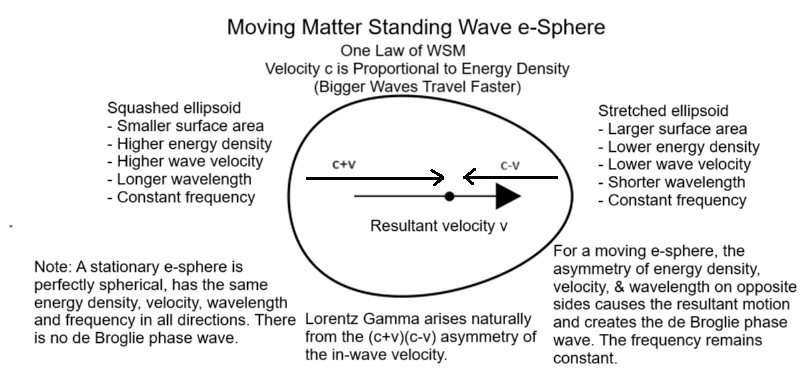
The moving wave egg has a physical leading and trailing side. At fixed intrinsic carrier frequency, the directional One-Law closure wavelength obeys
| Directional sector | \(E_d\) | \(c'\) | \(\lambda_{\rm cl}\) |
|---|---|---|---|
| Motion-leading | lower | lower | shorter |
| Motion-trailing | higher | higher | longer |
The two independently defined motion ledgers agree in sign. If \(+\) labels the motion-leading reciprocal component, then \(\lambda_+^{\rm ctrl}=\lambda_e^{\rm ctrl}e^{-\eta_v}\) is shorter than its rest value, just as lower leading \(c'\) gives shorter \(\lambda_{\rm cl}=c'/f_e\). This is a useful cross-check, not an identification: the finite H11 solution must still join the reciprocal-component and One-Law closure wavelengths.
This leading/trailing ledger belongs to translation and is distinct from the phase-relational forward/rear interaction curves of §30. It describes directional wave sectors; the complete equal-time contour and any recentered \(P_3\) egg are outputs of the moving solution. The odd fore–aft contrast supplies momentum direction, while the complete background-relative Hamiltonian excess remains even under \(v\mapsto-v\) and supplies kinetic energy. C
Real Lorentz deformation. The object does not remain internally unchanged while coordinates contract around it. Moving matter is a different stable wave geometry. The carrier resonance remains universal; the directional closure wavelength, wave speed, shape and de Broglie phase change.

Tier D · The moving-mode calculation now has an exact target. Begin with the regular open fixed point at \(b_0=\pi\sqrt3\), \[ \mathcal M(b_0)^6z=z,\qquad J_{\rm net}=0, \] then continue through its complete angular state, active \(V_4\), bilocal return and higher sectors selected by nonlinear closure. Translation of that whole recurrence is the route to the reciprocal pair, directional \(c'\), ellipsoid and observed Lorentz–de Broglie phase, with \(\gamma\) emerging rather than being inserted.
18. The de Broglie phase frequency changes with motion; the carrier frequency does not
Given the reciprocal pair derived as the H11 moving-state target, its exact factorisation produces a larger-scale composite phase whose temporal frequency and spatial gradient depend on velocity:
They conditionally satisfy the invariant phase relation:
The phase algebra does not need Planck’s constant inserted. Give one completed physical cycle the as-yet symbolic action \(J_*\):
Then the measured energy–momentum relations follow algebraically:
The relativistic increase of energy is therefore not an increase of the invariant proper carrier. In the proposed identification it is the temporal coefficient of the complete moving phase. The spatial phase gradient is de Broglie momentum:
Comparison with the measured universal quantum of action identifies \(J_*=\hbar\). In WSM that equality is a target normalization of one real completed wave cycle, not an ontological ingredient added to Space.
One structure, separate motion ledgers. The fixed carrier \(\omega_e\) preserves the identity of the e-sphere. Direction-dependent One-Law closure wavelengths \(\lambda_{\rm cl}\) describe its internal moving constitution. Conditional on the reciprocal pair, the separate travelling-component wavelengths \(\lambda_\pm^{\rm ctrl}\) interfere to supply the axial Lorentz scale and spatial de Broglie phase gradient. The temporal coefficient \(\omega_{\rm ph}=\gamma\omega_e\) belongs to that composite phase; it is not a faster carrier.
| Velocity in the Lorentz control | Meaning |
|---|---|
| Underlying \(c'(\mathbf x,\hat{\mathbf n})\) | Physical directional propagation speed of the real Space waves under the One Law. |
| Centre/group speed \(v=\beta c_0\) | Translation speed of the complete moving wave structure. |
| de Broglie phase speed \(v_{\rm ph}=\omega_{\rm ph}/k_{\rm dB}=c_0^2/v\) | Velocity of equal composite-phase surfaces; not material transport and not local \(c'\). |
The radius ratio \(R/\lambda_0=\sqrt3/2\), a holonomy coordinate \(\epsilon=\sqrt3/2\) and a six-step rapidity coordinate \(\tanh s=\sqrt3/2\) are compatibility clues in different calculations. None makes \(\beta=\sqrt3/2\) an intrinsic electron speed. A real electron must possess a continuous family of translated solutions \(0\le |v|<c_0\). Likewise \(2\sqrt3\) belongs to a mean spherical phase-speed construction, not to a derived material or signal speed.
Composite phase, not a second massive medium. The relation \(\omega_{\rm ph}^2-c_0^2k_{\rm dB}^2=\omega_e^2\) is the invariant of the moving e-sphere’s beat phase. The underlying longitudinal Space waves remain the real carrier.
Three further consequences of the same reciprocal pair
Because the directional factors are exponentials of rapidity, successive collinear changes multiply component by component and therefore add rapidities:
The familiar collinear velocity-composition rule is thus already contained in the same reciprocal wave coordinate; it is not an additional moving-body rule.
Likewise, treating the composite phase relation at fixed proper carrier \(\omega_e\) gives
The group velocity of the composite Lorentz–de Broglie branch is exactly the centre velocity. This is not a new dispersion law for the elementary Space waves, whose free carrier remains luminal.
Finally, if the one-substance carrier lock \(\omega_e=\omega_0\) holds, then \(\lambda_e^{\rm ctrl}=\lambda_0\) and the phase-selected radius becomes
With \(J_*=\hbar\), the electron value is approximately \(2.101\,\mathrm{pm}\). It is a standing-wave phase scale, not a hard surface or asserted charge radius.
A Given the reciprocal pair, its factorisation, rapidity composition and Lorentz–de Broglie algebra are exact. B The moving e-sphere supplies the physical reciprocal pair. D Calculate its full directional profile, energy and the universal cycle action \(J_*\).
Translation, spherical rotation and the Dirac bridge
The same finite sphere carries translation and lifted orientation. Reciprocal opposed-wave imbalance writes the Lorentz–de Broglie phase. The regular spherical carrier has two lifted hands
The breathing and radial propagation patterns are the sum and difference of the two hands:
The four complex Dirac modes are not \(q\times h\). They are
The grade and rest/radial pictures are two bases of this same mode space. In the reciprocal-grade basis
With \(H=2^{-1/2}\begin{pmatrix}1&1\\1&-1\end{pmatrix}\), the exact basis change \(H\tau_xH=\tau_z\), \(H\tau_zH=\tau_x\) gives
Thus reciprocal propagation grades × two lifted orientations and opposite radial/rest-phase branches × two lifted orientations are not eight states; they are two descriptions of four modes. The charge-phase class \(q_\phi\), hand \(h\), topological degree and measured charge remain separate physical labels. Reversing spin changes the hand imbalance; reversing charge shifts phase against the sea. Their independence is essential. The minimal free Dirac algebra is constructed; the finite e-sphere projection decides the conserved norm, physical current, mass lock and charge-conjugation map. Minimal coupling through the derived phase connection gives the conditional baseline \(g=2\); geometry alone does not fix its coefficient.
19. Lorentz contraction is a real shortening of the wave structure
Only the dimension parallel to uniform motion contracts in the ideal isotropic background. Every atomic spacing, resonant bond and material ruler shares the change because each is built from the same e-sphere relations. The fundamental carrier does not need to slow. The reciprocal axial phase scale and the complete moving geometry change, so the real material structure shortens.
This is a statement about the physical equal-time wave state in a specified frame, not about the raw image registered by a camera. Light-travel-time differences across a moving object produce the Terrell–Penrose optical appearance; visual appearance and equal-time Lorentz deformation are separate observables.
A moving observer does not notice an internal mismatch: ruler, apparatus, wavelength and clock mechanism are all reconstructed by the same transformed standing waves. This is Lorentz’s insight completed by one-substance ontology.
Within WSM, deformation is not optional. An unchanged isotropic standing wave has zero translational momentum. Given the reciprocal moving pair, its axial control phase scale has the \(1/\gamma\) factor exactly. The detailed three-dimensional contour and One-Law \(c'\) profile are calculation outputs, but a real directional change of the standing-wave state is already required by motion itself.
A The Lorentz contraction relation is established mathematics and experiment; within WSM the necessity of a non-isotropic moving wave state follows from the motion theorem, and the reciprocal axial phase scale contracts by \(1/\gamma\). D The finite solve determines the full three-dimensional contour, constitutive profile and material response.
20. Proper time is path phase measured against the invariant carrier
The e-sphere’s fundamental resonance \(\omega_e\) is universal. Proper-time differences arise because the complete moving phase contains both temporal and spatial parts. Along the wave-centre trajectory \(dx=vdt\):
Therefore:
The temporal coefficient \(\gamma\omega_e\) grows with motion; the spatial de Broglie term subtracts more than that increase when evaluated along the moving centre. The exact normalized split is:
| \(\beta\) | Temporal \(\gamma\) | Spatial subtraction \(\gamma\beta^2\) | Net \(1/\gamma\) |
|---|---|---|---|
| \(0.500\) | \(1.154701\) | \(0.288675\) | \(0.866025\) |
| \(\sqrt3/2\) | \(2.000000\) | \(1.500000\) | \(0.500000\) |
| \(0.990\) | \(7.088812\) | \(6.947745\) | \(0.141067\) |
The three columns obey the exact identity \(\gamma-\gamma\beta^2=\gamma(1-\beta^2)=1/\gamma\). Thus time dilation is not a slowing of the intrinsic carrier. Algebraically it is the reduced net phase left after the spatial gradient is evaluated along the moving history. This is the precise sense in which the e-sphere’s internal Lorentz clock is a phase clock: \(\omega_{\rm ph}=\gamma\omega_e\) is the temporal coefficient of a moving interference pattern, but the centre samples both that coefficient and the spatial de Broglie gradient. Its actual tick is the invariant phase increment \(d\theta=\omega_e d\tau\), not \(\omega_{\rm ph}\) in isolation.
Time does not become a different substance for every observer. A moving e-sphere’s clock is the complete Lorentz–de Broglie phase sampled along its centre, \(d\theta=\omega_e\,d\tau\). Different clocks record different phase path lengths through one connected causal wave history.
The twin effect is a difference between complete phase histories. One twin changes moving wave state through acceleration and returns. The invariant carrier is the same in both; the integrated de Broglie/closure phase is not.
For uniform motion \(\Delta t=\gamma\Delta\tau\). For varying speed in the flat-background control,
A conditional The displayed phase algebra gives \(d\tau=dt/\gamma\) once \(\omega_{\rm ph}\) and \(k_{\rm dB}\) are accepted. D One transition-clock functional maps this phase to real atomic, optical and decay clocks.
21. Relativity of simultaneity is the tilt of equal-phase surfaces
A moving lattice of clocks defines simultaneity by equal derived phase after light-signal synchronisation. The de Broglie equal-phase surfaces of a moving standing-wave system are tilted relative to the rest description of Space. Events simultaneous for one moving phase network need not lie on an equal-phase surface of another.
Real causal connection, relative simultaneity. Events are joined by actual propagation and reclosure in Space. Operational simultaneity is a relation constructed by distributed clocks and light signals, and those equal-phase surfaces depend on motion.
22. Variable physical \(c'\), constant locally measured \(c_0\)
Begin with the thing that physically moves. A plane wave is a real longitudinal displacement and stretching of the one elastic Space. As that plane passes through an e-sphere, the e-sphere’s directional \(E_d\) changes the local \(c'\), so the central part of the plane leaves ahead of or behind its flatter surroundings. The result is a real curve cut into a real moving plane front. For a resting uniform control it is a half-sphere; for a moving e-sphere it is a direction-dependent half-egg whose position, depth, width, orientation and fore–aft asymmetry follow the wave egg seen from that plane-wave direction.
Every e-sphere is already doing this to plane waves arriving from every direction. A stable bound state writes the same ordered pattern repeatedly. When its centre, shape or stable standing-wave rule changes, successive plane fronts leave with a changed sequence of half-egg curves. That causally propagating change of real displacement is light. It is neither a second electromagnetic material nor a pellet made of “energy.” A bound-to-bound transition is the discrete-endpoint quantum-line case; generic acceleration can write a continuous outgoing disturbance without being mislabeled a bound transition.
The first line translates “phase change” into visible wave motion: where \(\Delta\tau<0\), a crest of Space is physically advanced; where \(\Delta\tau>0\), it is physically behind. The second line says that the photographed curve is the accumulated consequence of the speed change through the finite e-sphere. Fourier amplitudes, potentials and photon states are useful representations of this displacement history; they are not additional things travelling beside it.
The connection exists before any emission event. Source and receiver are temporary names inside an eternal reciprocal wave sea. Schematically, \[ u_a^{\rm out}=\mathcal T_a[Z_a]u_a^{\rm in}, \qquad u_a^{\rm in}=u_{\rm sea}+\sum_{b\ne a}G_{ab}^{\rm ret}u_b^{\rm out}. \] A bound change replaces one repeating rule \(\mathcal T_A^{\alpha}\) by another \(\mathcal T_A^{\beta}\). It does not create the plane-wave carrier from nothing; it changes the real curves already being written onto that carrier in all directions. “All directions” names the complete plane-wave basis, not equal intensity: the coherent transition pattern may have angular nodes.
Describing the same changed displacement as curved plane-wave screens or as an outgoing spherical multipole is a Huygens change of resolution. The plane waves show what is physically imprinted direction by direction; their coherent angular sum shows the spherical out-wave. They are not two mechanisms and the angular spectrum is not a second substance.
Let \(C_a^{\rm out}\) be the stable outgoing transformation associated with source state \(a\). The endpoint contrast is \(\Delta C_{ba}=C_b^{\rm out}-C_a^{\rm out}\), but the actual finite radiative solution is generated by the time-dependent transition path:
A stable repeating e-sphere has zero mean excess stress-action flux through a distant sphere. During a transition, the source e-sphere, its bound partner, the near wave connection, recoil and the outgoing changed displacement reorganise together. Energy is the conserved numerical measure of their real motion and strain; it is not a substance loaded into the curve and posted to a receiver:
A thin phase screen alone obeys
Parseval gives the same equality in the outgoing angular spectrum: a static curve redistributes directions without destroying wave action. Light from a changing bound e-sphere is therefore the complete Action-0.6 disturbance, not phase geometry alone:
Here \(\Pi_X=\rho_0\dot X\), and \(\Xi_{ba}\) is the filtered transition train read from the one material phase-space history. Its determinant change, Huygens screen, polar orientation and stress are constrained representations of \(\Delta Z_{ba}\), not extra canonical fields. Their stress flux balances the change of the source–near-wave organisation and recoil, and can reshape a receiver. Calling that balance “energy transfer” is correct bookkeeping; imagining energy as a separate cargo inside the wave is not.
Uniform translation does not radiate its steady envelope
There is an exact kinematic non-radiation result for the steady envelope sector. A rigidly translating profile \(F(\mathbf x-\mathbf vt)\) has Fourier support only on
The free Space-wave pole is \(|\omega|=c_0|\mathbf k|\). For \(|\mathbf v|<c_0\), those supports do not intersect at nonzero \(\mathbf k\), so the steady \(n=0\) envelope cannot continuously shed a free luminal wave merely because it translates:
This theorem is scoped to the steady envelope. A periodic moving e-sphere has Floquet support
Zero mean flux is not enough to silence the \(n\ne0\) sidebands. In an orthogonal asymptotic Floquet-channel basis, every open outgoing channel must have zero residue or the exact incoming–outgoing return required by the stable recurrence; cancellation only after summing unrelated channels or frequencies is insufficient. Acceleration or a changing bound state breaks that closure and launches the full canonical train. The same projection has a second sharp duty: although Space’s underlying wave motion is longitudinal, observed light has two transverse helicities and no independent scalar light mode. This is one arm of WSM’s surplus-mode test; §36 applies the same discipline to gravity’s two tensor polarizations and the silence of long-range scalar/vector modes.
For one monochromatic linear canonical normal mode, the free action gives
That is the real-wave meaning of light having directed momentum without rest mass: the momentum is a measure of the travelling displacement pattern and its conjugate stress, which has no stationary closed rest solution. A real train also obeys
The conjugate Fourier partners are two mathematical halves of one real disturbance, not photon and antiphoton species. Electron/positron phase classes belong to bound e-sphere closure. The train has positive background-relative Hamiltonian and momentum, but “energy” is the conserved measure of its real configuration—not a detachable substance travelling through Space. A structured finite curve can have a peak moving more slowly than \(c_0\); its causal front and elementary Fourier components remain luminal in the presently derived free sector.
| Layer | What is discrete | What remains continuous |
|---|---|---|
| Source | Stable bound mode labels and differences between solved stable modes. | Launch time, transition path and finite linewidth. |
| Train | Central difference frequency, symmetry and angular selection. | Envelope, direction, phase and real propagation path. |
| Receiver | Closure into a new stable mode or durable record. | Accumulated driven response before nonlinear completion. |
The underlying carrier, the spatial repeat of the changed pattern, the material ruler and the receiving transition clock are different levels of one Space. A real Michelson–Morley, Kennedy–Thorndike or time-of-flight comparison measures their common response and returns \(c_0\) in the operational Lorentz limit.
Here \(\mathsf M_\Xi\) is the positive mode metric induced by the Action-0.6 Hamiltonian on the filtered transition train. The arriving curved-plane sequence continuously changes the receiver’s real displacement, strain and momentum through its susceptibility. Nonlinear closure into another stable receiver mode—or a durable amplified record—supplies the discrete completed event.
Delay is not automatically redshift
Let a crest or repeated curve be emitted at \(t_{\rm em}\) and arrive after a path time \(T(t_{\rm em})\):
A fixed delay moves every crest by the same amount and changes phase, not frequency. Gravitational redshift compares the reclosure rates of real emitter and receiver clocks in the gravity state; Shapiro delay is a path-time effect; cosmological redshift must progressively stretch the separation of successive half-egg screens. Curvature alone is also insufficient: on the WSM branch the slower curve follows the physical chain greater curved area at fixed action, frequency and thickness → lower directional loading \(E_d\) → lower \(c'\).
| Velocity ledger | Do not confuse it with |
|---|---|
| \(c_0\): causal front of the free longitudinal Action-0.6 equation | The speed of a finite nonlinear peak. |
| \(c'\): local directional characteristic speed | The centre speed of matter. |
| \(v_{\rm curve}\): speed of a written peak or envelope | The causal front; in the small-amplitude limit the front remains \(c_0\). |
| \(v_{\rm centre}\): e-sphere translation | The de Broglie phase speed. |
| \(v_{\rm ph}=c_0^2/v_{\rm centre}\) | Energy, matter or signal transport. |
| \(c_{\rm measured}\) | Bare \(c'\); it is a completed signal/ruler/clock comparison. |
One causal propagation, two centre-relative roles. An incoming acceleration or transition curve reaches the e-sphere and supplies a tiny directed drive. Its exact odd angular geometry contains a \(V_1\) translation projection and, after recentering, a predominantly \(V_3\) deformation, with even nonlinear products reaching \(V_0,V_2,V_4,V_6\). This first-order curve-driven \(V_3\) is not the same object as the history-free steady-motion scalar \(V_3\), whose first symmetry-allowed order is \(O(\beta^3)\). The internal energy distribution changes with the whole receiver state. That is how a massless travelling change can deliver momentum to massive standing-wave matter. The outgoing pattern then records the centre and shape produced by the earlier writing event: future-forming on arrival, past-carrying on departure.
“Special relativity is founded on the basis of the law of the constancy of the velocity of light. But the general theory of relativity cannot retain this law. On the contrary, we arrived at the result that according to this latter theory the velocity of light must always depend on the co-ordinates when a gravitational field is present.”
Albert Einstein, Relativity: The Special and the General Theory, Part II (English edition, 1954).Einstein’s sentence concerns the coordinate speed of light in a gravitational field within GR. WSM’s \(c'(\mathbf x,\hat{\mathbf n})\) is instead proposed as a physical local characteristic of real Space. The two statements can agree in observables, but they are not the same premise and the quotation should not be used as though Einstein had asserted the WSM ontology.
The two theories meet at measurement. Einstein makes locally measured \(c_0\) fundamental. WSM supplies a concrete one-substance reason it should emerge—signal, ruler and clock are modes of the same Space. D Their quantitative joint response is the apparatus-level calculation.
Where \(4\pi\), permittivity and permeability sit in normalized units
The familiar electromagnetic constants satisfy
If \(c_0=1\) and the Coulomb normalization \(1/(4\pi\varepsilon_0)=1\) is chosen, then
This is an exact placement of the spherical-flux factor within that unit convention, not a derivation of electromagnetic constitution. It must also be distinguished from the normalized longitudinal impedance of Action 0.6. Their physical connection is made by the reduced source–receiver response.
Driven propagation is not a quantum transition. Gravity and motion continuously change wavelength, phase and standing-wave closure; they need not push an e-sphere into another bound state. Emission and detection are resonant state-changing events at the endpoints. Reflection, refraction, bending, Shapiro delay and gravitational clock comparison are driven propagation and material-response processes between them. This keeps the Relativity and Quantum ledgers joined without confusing transport with transition.
23. A real Space and operational Lorentz symmetry coexist
Space is real, so motion relative to its local physical state is meaningful. The quantitative WSM target is nevertheless exact operational Lorentz covariance: every internal experiment in a uniformly moving closed laboratory must return the same laws because matter, transition trains, rulers and clocks are rebuilt by one common moving wave relation.
WSM synthesis. Ontology contains one real Space, an invariant carrier scale and real vibratory motion. Measurement displays Lorentz symmetry because rods, clocks, matter and light are all generated by the same Space and transform together.
The absence of an internal Galilean ether-wind signal does not erase Space. It says that no internal standard escapes the common transformation. The CMB dipole supplies an external velocity relative to the large-scale radiation state; WSM identifies that state conditionally with the large-scale rest state of Space. Uniform motion gives \(\Delta t=\gamma\Delta\tau\); a changing history uses the complete phase integral of §20. Neither relation turns the evolution coordinate into a second physical substance.
24. The CMB dipole defines a distinguished radiation frame
The cosmic microwave background is not isotropic in every state of motion. Its dipole anisotropy identifies the frame in which the large-scale background is maximally isotropic. This is an empirical distinction among states of motion relative to the surrounding universe.
Planck’s Solar-system barycentre result gives a dipole velocity of \(369.82\pm0.11\,\mathrm{km\,s^{-1}}\), corresponding to \(\beta=(1.23357\pm0.00036)\times10^{-3}\). This is the clean numerical benchmark for the external cosmic frame used on this page.
The history-free scalar selection theorem then gives a clean cubic discriminator:
This is not a predicted octupole until the real write/read weighting fixes \(\kappa_3\). It is the exact scale at which a steady recentered \(P_3\) wave-egg residue must be sought if that branch is physical.
WSM interpretation. WSM conditionally identifies the CMB rest frame with the observable large-scale rest frame of the wave state of Vibrating Space. Motion relative to it produces the dipole. Local Lorentz covariance and a distinguished cosmic background frame are not contradictory: the local laws retain the same form, while the actual external state of Space is physically different in different frames.
A sealed laboratory cannot determine absolute translation through internal co-transformed standards alone. A laboratory that observes the external cosmic wave background can determine its motion relative to that background. The CMB anisotropy is therefore empirical evidence consistent with more physical structure than an abstract equivalence of coordinate frames. The observation establishes a cosmological radiation frame; identifying it exactly with the microscopic rest state of Space is a WSM hypothesis that must be connected to the background-wave solution.
Preferred-frame gravity is a decisive audit, not a philosophical objection
Real Space may define the physical state while local rods, clocks and signals still reproduce Lorentz symmetry. Gravity faces the same precise audit. The moving-source solution calculates the preferred-frame PPN parameters \(\alpha_1,\alpha_2,\alpha_3\), excludes observable wakes or direction-dependent gravity, and shows how the CMB frame enters as the state of the surrounding waves rather than as an inadmissible local force term.
As a representative PPN benchmark, Will’s 2014 review quotes limits at roughly \(|\alpha_1|\lesssim7\times10^{-5}\), \(|\alpha_2|\lesssim2\times10^{-9}\) and \(|\alpha_3|\lesssim4\times10^{-20}\) under the stated PPN assumptions. These are not timeless constants or a substitute for the latest experiment; they show how strongly a concrete preferred-frame gravity model is already constrained.
A parabolic gravity law fails this audit immediately. Hyperbolic propagation at \(c_0\) is necessary, and the same calculation must make matter coupling, source motion and receiver response reproduce the observed suppression of preferred-frame effects. This is a sharp empirical test of WSM’s claim that real Space and operational Lorentz symmetry coexist.
Part III — Inertia and acceleration
25. Acceleration changes the complete wave state
Uniform motion is a stable moving mode. Acceleration is continuous motion through neighbouring translated and ellipsoidal e-sphere states, with any recentered \(P_3\) egg determined by the finite dynamics. The invariant carrier remains the identity of the resonator, while directional speed, wavelength, de Broglie phase, centre, shape, momentum and surrounding wave relations reorganise. Each real change also changes the pattern written on continuing outgoing plane waves: an accelerated charge radiates because its persistent curve relation is no longer repeating unchanged.
Conversely, a curve arriving on a plane wave is not an abstract force. It is a real phase-and-curvature mismatch across the receiving e-sphere: the constituent waves now meet at physically different positions in Space. A pure sky dipole translates the complete spherical carrier exactly, at any amplitude:
This is a centre displacement, not yet a force. Its spatial gradient is the directional phase/momentum read. Persistent acceleration is the third read: an imbalance of real incoming and outgoing Noether stress.
Before any response matrix is inverted, translation invariance supplies an exact neutral mode for a solved isolated e-sphere. If \(Z_e(\mathbf x)\) is a stationary solution and \(\mathcal L_e\) its linearised operator, differentiating the translated family \(Z_e(\mathbf x-\Delta\mathbf x_c)\) gives
An arriving curve can therefore project onto this exact translation direction and onto internal deformation modes at the same time. Momentum transfer and deformation are two projections of one real incoming disturbance, not two unrelated mechanisms.
Here \(J_{\rm curve}\) is a generalized overlap drive. Its \(V_1\) component may be integrated as delivered momentum only after projection identifies it with the stress flux above. The coordinate \(\Delta x_{c,\parallel}\), its conjugate momentum and the force are three successive objects; the receiver susceptibility joins them while also determining the ellipsoid, any \(P_3\) egg and the internal energy redistribution.
The neighbouring-steady-egg picture has a clean adiabatic range:
When \(\epsilon_a\) is not small, the near and far sides cannot reclose as simultaneous steady shapes; internal retardation and radiation become part of the acceleration itself. Non-collinear changes have a further exact benchmark: the orientation of the moving egg must reproduce Wigner–Thomas rotation,
This is why acceleration is locally detectable while uniform motion is not. An accelerometer measures the sustained failure of the local standing-wave network to follow free Huygens reconstruction.
26. Inertia is resistance to standing-wave reorganisation
Inertial mass is not a substance stored at a point and not a change of the universal carrier frequency. It is the characteristic response of a stable finite resonant wave structure when its directional wavelengths, ellipsoidal shape and de Broglie phase must change while resonance is preserved.
The established relativistic control relation is
Its curvature measures the observed energy required to change momentum, but it does not derive inertia: \(m\) has already been inserted into the dispersion relation. WSM’s task is to calculate \(E(p)\), its curvature and the value identified as mass from the moving e-sphere action. The proposed physical cause is the reorganisation of the complete finite structure and its surrounding wave relation without loss of carrier closure.
The action-level definition is background-relative:
For the translated Action-0.6 family, the collective inertia tensor is the velocity Hessian of the complete background-relative Hamiltonian:
The energy and response definitions must meet. If \(E_{\rm rel}(\beta)\) is the solved background-relative energy of the moving family, define
The same \(M_{\rm phys}\) must appear as the low-frequency coefficient of the dressed translation response after the internal deformation coordinates have been eliminated through their Schur complement. That equality is a strong internal conservation check: inertial mass cannot be one number in the energy ledger and another in the receiver susceptibility.
Inertia is therefore the real energetic cost of reorganising the entire recurrent wave structure through Space, not a label attached to a point.
Tier D · Decisive calculation. The moving and accelerating finite e-sphere returns \(\mathbf F=d\mathbf p/dt\) from real wave-energy flow.
27. Machian support — local matter is globally sustained
The e-sphere’s in-waves are supplied by the active calm sea, globally conditioned by the matter–Space and Huygens environment. Its local inertial form therefore presupposes that connected network without making pre-existing matter the creator of the underlying sea. Mach’s idea becomes a real wave mechanism: the universe is not a distant set of masses that later acts on an already existing body; it participates in the conditions by which the body exists.
Part IV — Equivalence and gravity
28. Why one continuous Space makes equivalence natural
“It is an unsatisfactory feature of classical mechanics that in its fundamental laws the same mass constant appears in two different roles, namely as ‘inertial mass’ in the law of motion, and as ‘gravitational mass’ in the law of gravitation.”
Albert Einstein, “Physics and Reality” (1936).Haselhurst’s foundation-level deduction. In WSM there is one continuously connected Space, one kind of standing-wave matter and one directional One Law. Inertia is that organisation responding when acceleration changes its directional wave balance. Gravity is the same organisation responding when surrounding waves arrive with a spatially changing balance. No independent gravitational substance or second material property is available. Equivalence is therefore the natural identity of one physical process, not an unexplained coincidence between two labels.
The one-action identity has three reads of the same normalized wave organisation:
Active is the source’s compactly generated phase-even long-range residue. Passive is the receiver’s coupling to that residue. Inertial is the energy curvature and dressed translation response of the moving family. Linearising one periodic e-sphere puts all three inside one Floquet response,
Here \(J_{\rm ext}\) is response notation for the arriving wave imbalance that drives the solved e-sphere. It is not an additional external-force or current substance.
Different atoms can have different internal spectra while sharing the same normalized centre response. In residue language the universal even block is rank one,
Charge and gravity may occupy distinct odd and even long-range coordinates, giving rank two overall, but each physical block remains rank one. A second direction inside the even block would be a composition-dependent force. Constituent, binding, excitation and collective wave energies must therefore combine into the same total inertial mass that controls translation.
The muon is the cleanest mass-weighting test
If the odd and even interactions factor symmetrically into source and receiver vertices, the required per-vertex gravitational/electromagnetic coupling target is
| Particle | \(\epsilon_m\) | Relative to electron |
|---|---|---|
| Electron | \(4.89960\times10^{-22}\) | \(1\) |
| Muon | \(1.01308\times10^{-19}\) | \(206.7683\) |
| Proton | \(8.99642\times10^{-19}\) | \(1836.1527\) |
These are calibration targets, not measured microscopic curve ratios. Their lesson is exact: equal charge magnitude cannot by itself determine the even source. The phase-even channel must read the complete rest-energy, carrier and binding organisation. MICROSCOPE then tests the resulting universal passive/inertial ratio at the few-\(10^{-15}\) level.
B One substance and one response law make equivalence structural. D One Noether/Floquet identity returns the common active, passive and inertial normalization, including binding energy and \(G\).
29. Falling is continuous wave reconstruction through a gradient
Where propagating wave trains have accumulated unequal directional retardation, they arrive at an e-sphere with different phase, speed and wavelength relations while preserving the universal carrier. Gravity is therefore not merely a scalar \(E_d\) level. The weak-gravity wave state needs a common \(V_0\) delay—represented in the reduced mathematics as a potential—together with a directional gradient and \(V_2\) tidal arrival structure:
The old centre no longer closes symmetrically. The incoming delayed phase is future-forming relative to this centre: it determines where the next interference maximum can close. The stable balance point shifts toward the side from which the delayed wave arrives—toward the source, not onward along the propagation direction of that incoming wave—while the outgoing waves retain the retarded record of the earlier centre. The body is continuously reconstructed toward the source.
There is an exact reconstruction-displacement lemma inside this picture. Put the source on the left and let its right-going wave arrive with a positive delay \(\tau\), so \(\phi=\omega\tau>0\). Against the unchanged left-going component,
The standing-wave centre therefore moves to
This is the one-dimensional face of the exact three-dimensional centre theorem. If the two opposed fronts have spatial displacements \(\zeta_+\) and \(\zeta_-\), their reconstructed centre is
A one-sided phase shift has \(\zeta_+=\phi/k\), \(\zeta_-=0\), giving \(-\phi/(2k)\). A sky dipole \(\zeta(\hat{\mathbf n})=\mathbf a_\phi\!\cdot\!\hat{\mathbf n}\) advances one pole by \(+a_\phi\) and retards the other by \(-a_\phi\), so the opposed difference is \(2a_\phi\) and \(\Delta\mathbf x_c=-\mathbf a_\phi\). The apparent factor of two is only the difference between one changed front and two oppositely changed poles.
The centre lies toward the delayed wave and hence toward the source. This fixed-\(\phi\) identity establishes the sign of the reconstructed position. Persistent attraction follows when the complete incoming–outgoing stress transfers canonical momentum in that same direction. The causal chain is
For a weak reduced exterior \(\varphi_{\rm even}\sim1/r\), its gradient has inverse-square range and its Hessian inverse-cube tidal range. The source amplitude, \(G\) and receiver normalization are one blind product.
Physical free fall. A falling body is not a particle pulled through empty space. It is a constant-frequency standing-wave structure whose next stable centre is formed by unequal surrounding wave speed, wavelength and phase relations.
In a freely falling laboratory, local matter and local light share the same changing environment, so their relative behaviour approaches the inertial form. This is Einstein’s elevator expressed as real wave dynamics.
30. Forward and rear curves — charge odd, gravity even
C The physical proposal in one visible experiment. Send a broad plane wave through a large neutral body. It crosses an immense number of e-sphere recurrences. Opposite radial phases write forward and rear signed curves, so the large phase-odd charge displacement nearly cancels. Yet either sign of real curvature spreads the directional relation and lowers its effective \(E_d\) relative to the flatter front. By the One Law, both curved sectors are slower. Signed displacement can cancel; positive travel-time delay cannot cancel in the same way. After repeated writing, propagation and reclosure inside the material source region, the transmitted plane wave leaves with a small phase-even rear curve across its front. That is WSM’s physical explanation of gravity.
A curve is a real displacement written across a continuing plane wave. “Forward” means ahead of the locally flat reference front; “rear” means behind it. The source writes its own outgoing disturbance; that disturbance cannot know the phase of a receiver it has not reached. Separate compact source formation, causal propagation and receiver response:
Here \(J_{\rm even}^{\rm src}\) is formed within the compact body and is weighted by its complete rest-energy organisation. Only the local overlap at the receiving e-sphere forms \(\sigma=q_sq_r\). Same relative phase produces the forward charge-reconstruction branch; opposite phase produces the rear branch. Their centre displacements have opposite signs. Repulsion or attraction is the maintained receiver stress response, not a verdict carried in advance between two centres.
A · quadratic coherent-wave control The elementary identity
proves the even self-part and phase-reversing cross-part for a quadratic two-wave read. The finite-amplitude cosh/Bessel harmonic expansion supplies the nonlinear control; the physical directional \(E_d\) is the characteristic response of the living e-sphere.
Microscopic mirror control; compact-body even source; exterior correction
The ideal single-e-sphere control is most cleanly written in normalized slowness, because travel time—not arithmetic speed—adds along a real path:
For this deliberately pure mirror parametrisation,
For the perfect one-radius hemisphere across a diameter, \(\delta(0)=1/2\), so the exact straight-chord effective speeds are the Abel results
If the odd and even interactions factor into symmetric source and receiver vertices as in §28, the electron calibration fixes the required elementary even-to-odd source ratio:
D · R4 magnitude target This number does not derive \(G\): \(\epsilon_{m_e}\) was reverse-engineered from measured \(G\), \(m_e\), \(\alpha\), \(\hbar\) and \(c_0\). It tells the action solve what must emerge without inserting \(G\). Its physical reading is powerful and positive: gravity is weak because the ideal forward/rear write is almost exactly mirror-symmetric in slowness; the elementary mass-weighted gravitational source is the minute phase-even departure from that symmetry.
This exact elementary control does not prove that a macroscopic neutral body has zero even output. A real body contains successive writing, propagation and reclosure intervals. At its boundary the transmitted front has the more general form
Outside the compact body, keep two even ledgers separate:
\(g_{\rm src}\) is the leading mass-weighted even state formed through matter and propagated by its own causal exterior coordinate. \(g_{\rm prop}\) is any additional nonlinear delay generated as already-written exterior curves widen and lose directional coherence. It is a real candidate correction, not a second copy of the Newtonian source.
| Gravity hierarchy | Quantity | Status and required connection |
|---|---|---|
| Ideal signed write | \(\delta_{\rm micro}=1/2\) | A Exact straight-chord Abel control for the one-radius hemisphere. |
| Elementary even departure | \(g_{\rm src}^{\rm micro}\simeq2.44980\times10^{-22}\) for the electron | D R4 calibration target under symmetric source/receiver factorisation; not yet an action-derived prediction. |
| Compact material source | \(g_{\rm src}(B)\) | Derive repeated writing, binding, composition and total rest-energy weighting inside the body. |
| Leading exterior state | \(\psi_{\rm even}\propto1/r\) | Exact Green-class range once Action 0.6 identifies and normalizes the compact reduced source. |
| Exterior correction | \(g_{\rm prop}\) | Possible subleading nonlinear evolution; it must not duplicate or replace the compact source. |
| Universal normalization | \(G\) | The same derived coefficient must govern static gravity, passive response and gravitational radiation. |
Convex travel-time lemma. A separate exact control shows how symmetric first-order speed changes can leave an even delay when travel times are averaged:
For \(c'_{\pm}/c_0=1\pm\epsilon\), the odd and even slowness parts are
The premise is symmetric speed, not symmetric slowness. It is therefore not the WSM microscopic Abel write, whose speeds \(2c_0\) and \(2c_0/3\) are strongly asymmetric while its slownesses \(1/2\) and \(3/2\) are exact mirrors with zero mean excess. For an elementary speed contrast of order unity the convex ratio is also of order unity, not \(10^{-22}\). The convex lemma is consequently excluded as the microscopic origin of \(g_{\rm src}^{\rm micro}\); it remains a useful sign control for a separately derived macroscopic-body average or exterior correction. The living source calculation must supply the tiny mass weighting, range and normalization.
Charge and gravity are different moments of one real history. Charge is the receiver’s phase-odd response to signed curvature. Gravity is the compactly generated, phase-even delay that survives neutral cancellation and then propagates causally. Further exterior curvature evolution may add \(g_{\rm prop}\), but it does not create the leading mass source from the square of a distant charge tail.
The visible hemisphere geometry
With \(\mu=\hat n\!\cdot\!\hat z\), the literal forward and rear hemispherical heights are
A · bare geometry The signed hemisphere is a pure translation dipole. It contains no \(P_3\). An octupole enters only if the physical write/read map supplies one additional factor of \(|\mu|\), for example through projected area, crossing flux, Huygens weighting or receiver susceptibility. Under that stated weight,
Under the ordinary angular norm \(\|f_w\|^2=\int_{-1}^{1}|f_w|^2d\mu\), the \(V_1\) projection carries the ordinary-measure dipole share \(15/16\); after recentering, \(V_3\) carries \(35/36\) of the remainder; \(V_1+V_3\) accounts for \(575/576\) of the original norm. Under the different Huygens/flux weight \(2|\mu|d\mu\), a weighted least-squares regression onto \(P_1\) captures \(24/25\) of the norm. That is not an orthogonal Legendre partition because \(\langle P_1,P_3\rangle_{2|\mu|}=1/6\ne0\). These exact numbers apply only after the profile and measure are stated once. They are response norms, not energy fractions. The physical weighting and resulting \(P_3\) egg are respectively Tier C and Tier D.
If the physical map supplies the weighted even control \(\mu^2\), its simplest quadratic area/intensity response necessarily reaches fourth order:
The recentered octupole has an equally sharp nonlinear ledger:
Thus \(V_4\) cannot simply be deleted: a quadrupolar curve writes a fourth-order companion, while octupole self-coupling reaches \(V_6\). The often-used \(V_0\oplus V_2\oplus V_4\) state is a minimum retained angular sector through \(\ell=4\). D The finite mode classifies higher sectors as slaved, bound, negligible or radiative.
After writing — both real curves have excess area
A non-flat graph \(\zeta(x,y)\) over a fixed aperture has more area than its tangent plane. Removing uniform tilt, which merely changes propagation direction, gives the intrinsic small-slope excess
For a quadratic patch \(\zeta=\tfrac12K_{ij}x_ix_j\) measured over a circular aperture of radius \(L\),
The support scale matters; there is no unique area cost without it. In the compact source calculation, \(L\) is the curve’s own support selected by the e-sphere or body solution—naturally of microscopic e-sphere scale for one elementary write, but not fixed by assertion. In an exterior propagation correction, the evolving support is a separate \(L(D)\). A receiver aperture must never be used to manufacture the source strength. Exact mirrors \(\zeta\) and \(-\zeta\) have equal area at ideal writing; repeated material interaction and nonlinear propagation determine how their later directional energies evolve.
At fixed curve action \(\mathcal J\), temporal frequency \(\omega\) and effective thickness \(\Delta\), the modulation density obeys
Thus either curved sign dilutes its carried modulation relative to a matched flat patch under those controls. The complete directional response is
On the WSM branch where the curve’s directional response follows this dilution, both signs travel more slowly than the locally flatter plane around them. Repeated across the finite material body, this is the physical origin of \(g_{\rm src}\): forward and rear charge curves can cancel as signed displacements while their positive delays add. Beyond the body, the same geometry can generate the smaller \(g_{\rm prop}\) correction. The complete \(E_d^{\rm total}\) includes sea, cross, binding and coherence terms, allowing one action to determine the source weight and evolving exterior profile.
| Stage | Forward relation | Rear relation |
|---|---|---|
| Ideal microscopic write | One-radius forward hemisphere; \(c'_{\rm eff}=2c_0\) in the straight-chord control. | One-radius mirror rear hemisphere; \(c'_{\rm eff}=2c_0/3\). |
| Neutral source region | Repeated writing and reclosure cancel most odd displacement while adding a mass-weighted phase-even delay \(g_{\rm src}\). | |
| Exterior propagation | The independently formed even state propagates causally; continuing nonlinear curve evolution may add the subleading \(g_{\rm prop}\). | |
| Receiver | Same phase reads the odd displacement sign; stress decides maintained repulsion. | Opposite phase reads the reverse sign; stress decides maintained attraction. |
Exact ray-screen range audit. For a local slowness/index trace \(\chi(r)=\kappa_n/r^n\), \(n>1\), a straight ray at impact parameter \(b\) receives
A local \(1/r\) index gives the finite-endpoint logarithmic delay and \(1/b\) bending required by leading gravity. A \(1/r^2\) index gives \(\zeta_2=\pi\kappa_2/b\) and a \(1/b^2\) slope: a steeper correction. Most importantly, if the already-propagated odd slowness tail behaves as \(\delta_{\rm ext}\sim r^{-2}\), an exterior even term quadratic in that tail has
That conditional \(1/b^3\) screen is three powers too steep in the local index to lead Newtonian gravity. It may survive as a small exterior correction. The leading \(1/r\) state must descend from the compact mass-weighted even source carried by the reduced coordinate of §31.
Transparent phase writing is not force. In one dimension a constant-impedance variable-speed profile can write a finite phase and yet receive exactly zero steady net force when it returns to the same exterior state. WSM force therefore lives in three-dimensional redistribution, receiver reclosure and incoming-minus-outgoing stress—not in the bare statement \(c'\ne c_0\).
One-metre electron benchmark. Two electrons one metre apart supply an unforgiving reverse-engineering target:
During one full electron Compton period \(T_C=h/(m_ec_0^2)=8.09329978\times10^{-21}\,\mathrm s\), one receiver changes by
Those numbers constrain one complete causal product—source writing × one-metre propagation × receiver overlap × stress-to-translation response. They do not determine the source-only curve by themselves. The calculation becomes successful when the forward hemisphere at emission, its flattening and widening over one metre, the receiver’s changed egg and the integrated stress return this acceleration with no fitted receiver factor.
Scale comparison: one electron at 1 m and the whole Earth
C · receiver-response calibration If the weak gravity phase per electron carrier cycle is written as
the receiver mass cancels from that phase ledger. At Earth’s surface, \(|\Theta_g|=4.371\times10^{-9}\,\mathrm{rad}\) per cycle, equivalent to a Compton-front displacement \(|\zeta|=1.688\times10^{-21}\,\mathrm m\). Under the same centre-response convention this is \(|\Delta\beta|=2.649\times10^{-28}\) per cycle. The one-metre electron benchmark above gives \(\Delta v/c_0=6.837\times10^{-27}\), only \(25.8\) times larger. This is a vivid receiver-scale comparison, not a derivation of either source curve or equivalence.
31. Action 0.6 and the reduced causal \(1/r\) coordinate
Action 0.6 already supplies the ordinary longitudinal wave pole. For a reduced odd or even coordinate \(\psi_A=\mathcal R_A[X]\) whose constrained source reduction closes canonically, the causal equation has the form
In the static limit, \(-\nabla^2\psi_A=\rho_A\), so a localized reduced source gives \(\psi_A\propto1/r\). Its gradient has inverse-square range and its Hessian inverse-cube tidal range. The static exterior is the persistent envelope of real waves causally renewed at \(c_0\), not an instantaneous influence. A stationary source loses no net energy merely by maintaining it:
The fixed homogeneous background mode is separated before the nonzero-mode operator is inverted. The decisive reduction is now wonderfully concrete: identify \(\psi_{\rm even}[X]\), derive its compact rest-energy source \(J_{\rm even}^{\rm src}[X]\), and normalize the same mode in source, receiver and radiation. The ordinary \(1/r\) Green class is ready; Action 0.6 determines which physical functional inhabits it.
| Receiver read | Real-wave meaning | Asymptotic role |
|---|---|---|
| \(J_A^{\rm src}[X]\) | Compact odd or even source functional of the one displacement and its recurrence. | Charge- or mass-weighted source residue. |
| Reduced \(\psi_A[X]\) | Ordinary positive-energy longitudinal collective coordinate. | Localized static source gives \(1/r\). |
| \(\nabla\psi_A\) | Wave-normal slope / momentum-gradient ledger. | \(1/r^2\). |
| \(\nabla\nabla\psi_A\) | Differential arrival curvature. | \(1/r^3\) tides. |
| \(\Delta T_{ij}\) | Incoming–outgoing real-wave stress. | Actual \(dP_i/dt\). |
Retired paired-coherence range route
The earlier paired sector used a raw coefficient with \(G_g(k)\propto k^{-3}\), repaired by
The Fourier algebra was exact inside that assumed sector, but Action 0.6 has replaced its independent paired field with constrained functionals of \(X\). The half-order projection is therefore preserved as useful history, not used as the current foundation.
Odd and even residues form locally, then share one causal propagation law
Several weak sources add in the propagating odd/even coordinates. Only at the receiver does its local phase \(q_r\) form the signed product:
For equal elementary residues this becomes
The displayed \(NC_{\rm even}\) is an equal-element toy ledger, not a composition law for a real atom or body. A phase-balanced body cancels its large odd charge-like response while the even part survives. The real composite source carries constituent, carrier, binding, coherence and collective weights whose sum is the same total inertial wave-energy that defines the body’s translation response.
The odd source reverses the receiver’s attraction/repulsion relation. The even source survives phase-balanced matter and carries the common delay. Both are disturbances of the same Space and propagate through the same retarded longitudinal Green response. For a localized nonzero reduced even residue,
These are three geometric readings of one wave state: accumulated canonical phase, wave-normal slope and tidal curvature. Actual centre acceleration follows only after the receiver stress converts the arriving state into \(d\mathbf P/dt\). The reciprocal curvature operator makes the hierarchy visible:
A constant and a uniform tilt vanish; curvature is the first reciprocal signal. Pure \(V_2\) changes relative arrival and shape but has zero angular mean. The common clock/delay residue therefore needs a \(V_0\) component as well as its tidal \(V_2\) signature.
Odd range does not create even range by squaring. If a charge-like odd response scales as \(1/r\), its square scales as \(1/r^2\); in the local-slowness ledger of §30, an \(r^{-2}\) odd tail squared gives the still steeper \(r^{-4}\) correction. The leading phase-even \(1/r\) coordinate is sourced in the compact material region and then propagated. It is not manufactured by squaring the distant exterior charge tail.
Coherent background cross-term — useful audit, not the source derivation
If a phase-locked spherical perturbation \(\delta u=(a/r)\cos(\theta+\delta)\) rides on a nonzero carrier \(u_0=A_0\cos\theta\), then quadratic measurement contains
The algebra is exact and shows why a background-relative observable can contain a linear \(1/r\) term. Its physical realization belongs to the reduced compact even source above.
A static \(1/r\) envelope is continually renewed by travelling waves; it does not propagate instantaneously. A parabolic diffusion equation may mimic the stationary profile but would leave wakes behind moving sources. The physical equation must be hyperbolic, and the same causal kernel must reproduce both its static pole and its radiative pole.
The complete gravity chain. E-spheres write opposite signed curves. Repeated interaction and reclosure inside neutral matter cancel the large odd displacement while forming the compact, mass-weighted \(J_{\rm even}^{\rm src}\). Causal propagation supplies \(\psi_{\rm even}\sim1/r\). The receiver reads its phase and slope; stress changes centre momentum and the Hessian changes shape. Nothing jumps across emptiness and no receiver property is carried backwards into the source wave.
Thin Einstein rings and sharp lensed images further require this exterior state to be a smooth coherent phase gradient, with microscopic phase noise far below its systematic deflection. Random scattering cannot replace the derived wave geometry.
A The retarded Green function and \(1/r,1/r^2,1/r^3\) hierarchy are exact for the displayed reduced wave equation. B Mirror writing → compact neutral-body even source → causal propagation → receiver stress is the WSM gravity architecture. D Action 0.6 selects \(\psi_{\rm even}[X]\), its total-energy weight, normalization and \(G\).
32. Einstein’s unfinished problem — one unified structure of Space
“But the idea that there exist two structures of space independent of each other, the metric-gravitational and the electromagnetic, was intolerable to the theoretical spirit. We are prompted to the belief that both sorts of field must correspond to a unified structure of space.”
Albert Einstein, On the Method of Theoretical Physics, Herbert Spencer Lecture (1933).WSM makes the unity literal. Electromagnetism and gravity are not independent materials inhabiting one Space. They are different ledgers of the same longitudinal wave relation:
| Ledger | One-wave reading |
|---|---|
| Charge | The persistent phase-odd source–receiver curve relation. |
| Light | A causal travelling change of that persistent relation. |
| Gravity | The compact phase-even lag formed as mirrored curves repeatedly interact and reclose through neutral matter, propagated by the reduced even coordinate and read through receiver stress. |
| Inertia | The positive cost of reorganising and translating the complete standing-wave/coherence structure. |
Matter changes waves; waves reconstruct matter. The out-wave carries the retarded curve pattern written by an e-sphere’s earlier centre and shape. The same wave becomes a future-forming boundary condition when it arrives at another e-sphere. This reciprocal loop is the physical content beneath electromagnetism, light, gravity and Machian connection.
“The special and general theories of relativity, which, though based entirely on ideas connected with the field-theory, have so far been unable to avoid the independent introduction of material points; the continuous field thus appeared side by side with the material point as the representative of physical reality. This dualism remains even today disturbing as it must be to every orderly mind.”
Albert Einstein, “Considerations Concerning the Fundaments of Theoretical Physics,” Science, 24 May 1940.One-substance WSM removes that dualism. The e-sphere is a finite resonant solution of Space, not a particle added to a field. The words particle and field survive only as useful experimental and mathematical shorthand: stable finite wave organisation on one side, derived moments and response functions of the same wave relation on the other.
33. The exponential metric as a conditional reciprocal-transfer reconstruction
A metric is not a second substance. It summarizes how derived transition clocks, material rulers and transported phase compare in one gravity state. The exponential form is not historically new: it appears in Papapetrou’s 1953 paper and in Hüseyin Yılmaz’s 1958 theory of gravitation. WSM offers a different physical road to that mathematical form—reciprocal transfer in one real longitudinal wave medium—not a claim of priority over the history.
Use far-background isotropic Space coordinates \(\mathbf x\), and keep the transfer factor \(N\), dimensionless reduced response \(\widehat W\), dimensional Action-0.6 energy \(W(J)\), total energy \(\rho_E\) and directional front energy \(E_d^{\rm front}\) on separate ledgers:
\(N\) is the candidate lapse/transfer factor in this zero-shift isotropic effective metric: it records amplitude and rate comparison relative to the far background. It is not the ADM shift vector. The conditional reduced branch gives the exact reciprocal factors \(\widehat W\pm\widehat P=e^{\pm s}\). Its delayed transfer hand is \(N=\widehat W-\widehat P=e^{-s_g}\). The factor \(\widehat W=\cosh s_g\) is a dimensionless stored-response control; it is distinct from \(N\), \(N^2\), \(W(J)\), total energy and the energy of one curved front.
“According to the general theory of relativity, the geometrical properties of space are not independent, but they are determined by matter.”
Albert Einstein, Relativity: The Special and the General Theory, §32 (1916; authorised English translation).WSM proposes to make the reciprocity physical: standing-wave matter changes propagating wave relations, and those relations change the waves that form matter. A metric can summarize the resulting clock, ruler and path comparisons after they are derived; it is not the substance or the source mechanism.
The reduced even-source construction supplies a concrete exterior to test. The radial null curve of the effective metric gives
The candidate clock and ruler intervals are \(d\tau=Ndt\) and \(d\ell=N^{-1}|d\mathbf x|\). Therefore the completed local measurement is exactly
Variable background-coordinate propagation and invariant local measured speed coexist inside the same metric dictionary. In WSM this is the mathematical target for the real transition clock and standing-wave ruler response.
The carrier ledger now closes without changing the electron’s intrinsic identity. With \(d\theta_{\rm car}=\omega_e d\tau\),
Locally, \(d\ell/d\tau=c_0\) and \(d\theta_{\rm car}/d\tau=\omega_e\); relative to the far-background coordinate, the propagation speed, carrier phase rate and closure wavelength carry the corresponding powers of \(N\). This is why every use of \(c'=f\lambda\) must keep its time and length coordinates on the same ledger.
A real transported amplitude multiplied by \(N\) carries a quadratic directional transfer measure multiplied by \(N^2\). This motivates the candidate identification
through the One Law’s far-background coordinate reading. There is no contradiction with \(\widehat W=\cosh s_g\): \(\widehat W\) is the reduced stored-response control, whereas \(N^2\) is the transported transfer candidate and \(W(J)\) is the dimensional Action-0.6 energy. In the weak-gravity limit \(s_g=\ell_g/r\), it gives \(c'_{\rm coord}/c_0=e^{-2\ell_g/r}=1-2\ell_g/r+O(r^{-2})\), matching the reduced \(1/r\) exterior.
The attraction sign runs end to end.
§29 proves the reconstruction sign; the complete stress response converts that continuing displacement into gravitational acceleration.
Let \(x=U/c_0^2>0\) denote the supplied standard weak-gravity potential coordinate. The exact expansion audit is:
| Candidate transfer factor | \(\gamma_{\rm PPN}\) | \(\beta_{\rm PPN}\) | \((2+2\gamma-\beta)/3\) | Meaning |
|---|---|---|---|---|
| \(N=1-x\) | \(1\) | \(1/2\) | \(7/6\) | Naive linear control: perihelion coefficient \(16.67\%\) high. |
| \(\boxed{N=e^{-x}}\) | \(1\) | \(1\) | \(1\) | WSM-native transfer candidate if \(x=s_g\) and \(N=\widehat W-\widehat P\) are derived. |
| \(N=\operatorname{sech}s,\;x=s^2/2\) | \(1\) | \(4/3\) | \(8/9\) | Scalar inverse-stiffness neighbour: coefficient \(11.11\%\) low. |
| \(N=\widehat W=\cosh s\) | — | — | inadmissible | Rejected control: the reduced stored-response factor is not the transfer factor and gives no slow-clock branch for positive \(s\). |
The nonlinear source map matters as much as the exponential transfer. If the solved gravity variable is
then
The source map required for \(\beta_{\rm PPN}=1\) is therefore \(s_g=x+O(x^3)\), not merely the leading \(1/r\) term. The earlier \(17\%\) discrepancy was not missing spatial curvature: \(\gamma_{\rm PPN}=1\) was already present. The linear branch supplied half the required quadratic coefficient in \(g_{00}\), whereas \(a=0\) gives the exact first-post-Newtonian pair \(\beta_{\rm PPN}=\gamma_{\rm PPN}=1\).
The cubic coefficient is the next sharp source-map discriminator. At \(a=0\), the pure exponential gives \(4/3\), while the isotropic-coordinate Schwarzschild expansion gives \(3/2\); the latter is matched exactly by
This is a coordinate-specific diagnostic of the static \(g_{00}\) series, not the whole post-Newtonian theory. The spatial metric, moving sources, radiation and observable coordinate dictionary remain independent checks.
Because \(\beta_{\rm PPN}-1=-a\), a representative weak-field bound \(|\beta_{\rm PPN}-1|\lesssim8\times10^{-5}\) in the 2014 PPN audit translates directly into \(|a|\lesssim8\times10^{-5}\) for this particular source-map expansion. The number is a benchmark under the PPN assumptions, not a substitute for deriving the full moving and nonlinear source.
Two reasons the exponential appears. First, the conditional reduced branch supplies reciprocal factors \(\widehat W\pm\widehat P=e^{\pm s}\). Second, if a derived gravitational rapidity or potential coordinate adds while successive transfer factors multiply, continuity requires an exponential map: \[ \varphi_{\rm tot}=\varphi_1+\varphi_2, \qquad N(\varphi_1+\varphi_2)=N(\varphi_1)N(\varphi_2) \ \Longrightarrow\ N=e^{-k\varphi}. \] The functional implication is exact. The physical premises—additive \(\varphi\), multiplicative transfer and its source equation—remain calculations.
This reciprocal product is a useful internal audit of the proposed branch. It is not a coordinate-invariant law and must not be imposed on a different radial gauge by notation.
Beyond first post-Newtonian order: exact Tier-C diagnostics for the Tier-D branch
If the exponential ansatz is continued unchanged, it and the isotropic Schwarzschild metric separate at the next orders:
The \(g_{00}\) cubic coefficients differ by \(-1/6\), which is \(-1/9\) relative to the Schwarzschild coefficient \(3/2\); the spatial coefficients also separate. These exact series become a WSM prediction when the Tier D exterior fixes the physical radial coordinate and clock, ruler, orbit and radiation observables.
What WSM inherits—and does not inherit—from Yılmaz
WSM is testing the exponential metric form; it is not adopting Yılmaz’s complete gravitational field equations or his treatment of gravitational stress-energy. Criticisms directed at those equations—including the “Yilmaz Cancels Newton” dispute—therefore do not automatically decide WSM. Conversely, the shared metric form does not solve gravity for WSM. The real-wave theory must supply its own causal source equation, conservation law, moving-body solution and measurement map.
The profile and metric meet as a sharp candidate. A localized reduced phase-even source supplies the weak-gravity \(1/r\) route; the reciprocal branch \(N=e^{-s_g}\) supplies a natural nonlinear transfer form and passes the displayed first post-Newtonian coefficient audit for redshift, bending, Shapiro delay and perihelion. Their common destination is the amplitude \(\ell_g=GM/c_0^2\), the clock/ruler dictionary and the finite strong-gravity continuation.
A The reciprocal algebra, local-\(c_0\) identity, exponential series and displayed PPN coefficients are exact for the written metric branch. B The reduced even source and \(N=\widehat W-\widehat P=e^{-s_g}\) are two ledgers of one gravity state. D Action 0.6 fixes their common normalization, \(G\), clock/ruler projection and nonlinear exterior.
34. Gravitational redshift, light bending, Shapiro delay and perihelion
One real-wave route, four classical measurements. Neutral matter forms a compact phase-even delay; the reduced even coordinate supplies the \(1/r\) exterior; its gradient gives inverse-square reconstruction; its ray integral gives logarithmic Shapiro delay and \(1/b\) bending; and the exponential transfer candidate supplies the correct first post-Newtonian metric coefficients. Redshift, bending, delay and orbital precession are four reads of one Space state, with one amplitude \(G\).
Gravitational clock shift
The fundamental e-sphere carrier remains the universal resonance. Real clocks count coupled transition, beat, rotation and closure phases. In a nonuniform gravity-transfer state, wavelength, propagation phase and composite resonance geometry differ between emitter and receiver. Their comparison gives gravitational redshift; the Tier D clock projection returns \(N\).
Three redshifts, three real-wave histories. Gravitational redshift compares clocks and propagation through a stationary spatial gradient. Shapiro delay is accumulated travel-time phase through that gradient. Cosmological redshift is a permanent widening of the arriving phase-repeat pattern over distance or history. Their measured similarities do not make their wave histories identical.
Light bending
A transition-modulation train traversing \(n(r)=1+2GM/(rc_0^2)+O(r^{-2})\) accumulates unequal phase through the One Law. Its transverse wavefront gradient gives:
Shapiro delay
A transition-modulation train crossing the candidate \(1/r\) gravity state accumulates \(\int dz/\sqrt{b^2+z^2}\), giving the required logarithmic dependence on impact parameter. This is a path-phase delay, not a cosmological frequency change.
Perihelion advance
A bound e-sphere moving through the nonuniform Space geometry accumulates a small mismatch between radial and angular phase closure. The target is:
These are not four separate forces. They are four measurements that must be produced by one derived wave profile acting on travelling light and constant-frequency standing-wave matter.
35. Rotating sources and frame dragging
Rotation of a standing-wave source changes more than its scalar delay. In the reduced equations this is represented by a circulating source-current ledger: physically, ordered transport of the same wave energy and coherence, not a second fluid or vector substance. The local \(V_2\) sector supplies the lowest tensor geometry; the complete rotating state may also carry active \(V_4\) and bilocal correlations.
The derived \(\mathcal A_i^{\rm red}[X]\) is a reduced shift/transport ledger of the one displacement map, not an independent vector field-substance. It must reproduce gyroscope precession, orbital-node shifts, synchronization and light propagation with the Lense–Thirring coefficient. A static scalar \(1/r\) profile cannot do this. Frame dragging is ordered circulation in the same longitudinal-wave organisation.
The Wigner–Thomas rotation of §25 and Lense–Thirring frame dragging both audit ordered, non-collinear transformation history, but they are not the same effect. Wigner–Thomas rotation is the kinematic result of composing boosts along an accelerated matter history; Lense–Thirring precession is the gravitational response to a rotating source. A completed one-Space action must recover both coefficients from their distinct source terms.
36. A real longitudinal rotor, two polarization quadratures and gravitational waves
An orbiting bound system turns its anisotropic residual-delay pattern through Space. If the completed source dynamics conserves its integrated same-sign source and centre of energy, it cannot radiate a changing monopole or dipole through those conserved channels. The leading changing pattern is then quadrupolar. For a circular binary the quadrupolar source moment is unchanged under a half-orbit reversal, so its leading rhythm is \(2\Omega_{\rm orbit}\). This gives the observed frequency skeleton of inspiral radiation directly from a rotating real-wave source, while leaving its power and full multipole content to the propagation calculation.
The scalar boundary is real—but WSM is not a scalar theory
A single retardation number \(\delta\tau(\mathbf x,t)\) is a \(V_0\) scalar. A wave made only from that scalar, or from \(k_i k_j\delta\tau\), produces breathing or longitudinal response. Even the axisymmetric traceless combination \(\hat k_i\hat k_j-\delta_{ij}/3\) is the \(m=0\) member of \(V_2\); its transverse-traceless projection is zero. Source quadrupole and frequency \(2\Omega\) do not by themselves determine polarization.
WSM contains more geometry than \(\delta\tau\). Six unoriented reciprocal-axis energy or strain samples form exactly
The common sum is the scalar \(V_0\) delay. The five independent redistributions with zero total form the complete local symmetric trace-free \(V_2\) space. Six directed phase channels are a different representation and must not be silently identified with these headless samples. After choosing a propagation direction,
Only the two-dimensional \(|m|=2\) plane has the local transverse-traceless \(+/\times\) geometry. The \(m=0\) and \(|m|=1\) pieces must be constrained, slaved into the e-sphere, bound, absent from the long-range residue or quantitatively below observational limits.
\(Q_{ij}\) is not another substance or a transverse medium inserted beside Space. It is the second directional moment of the one set of longitudinal waves—the changing distribution of real \(E_d\) among their six axes.
The spherical rotor writes both real quadratures into \(c'\)
Let \((\hat{\mathbf m},\mathbf e_1,\mathbf e_2)\) be a fixed orthonormal frame, with \(\hat{\mathbf m}\) the instantaneous ray direction. Define the rotating tangent direction and its rotating plane normal by
Because \(\hat{\mathbf n}_h\) rotates with \(\tau\), the projector sum below is not a constant plane projector. The squared longitudinal rotor is exactly
Equivalently, \(B_h^2=I-P_{\hat{\mathbf n}_h(\tau)}\). That form is fully consistent with the displayed double-phase decomposition precisely because \(\hat{\mathbf n}_h(\tau)\) is itself rotating. The calm term is its phase average; the \(T_+\) and \(T_\times\) terms are the real oscillating quadratures.
The remaining two real quadratures rotate with double phase and are precisely the \(+\) and \(\times\) directional forms. The sign \(h=\pm1\) selects the opposite order in which those quadratures are traversed—the candidate helicity or circulation hand—not \(+\) or \(\times\) separately. In the stated local constitution their phase-sensitive speed response is
Real longitudinal motion, two tensor quadratures. Squaring an axis-free longitudinal spherical rotor writes two double-phase patterns directly into directional wave speed. Nothing transverse has been added as a second substance. This is the exact local bridge from spherical rotation to polarization. D Collective propagation closes those quadratures into a positive-energy wave and carries them from source to detector.
The two transverse-traceless patterns are already inside \(V_2\)
Let \(P_{\hat{\mathbf n}}=\hat{\mathbf n}\otimes\hat{\mathbf n}\) denote the projector of one longitudinal direction. For propagation along \(\hat{\mathbf z}\), two differences of longitudinal projectors are
Both are trace-free and exactly transverse:
Under rotation through \(\psi\) about the propagation direction they mix through twice the angle:
The opposite circular or helicity orderings are conventionally compressed as
Here \(i\) records a quarter-cycle between two real patterns; it is not a complex substance. This is local spin weight two. Trace-freeness, \(Q_{ii}=0\), follows from the STF construction. The travelling projection adds the transverse condition \(k_iQ_{ij}=0\) and a positive-energy pole. Its constrained Hessian block must contain an eigenmode satisfying
The six icosahedral reciprocal axes already used for the local e-sphere frame reconstruct both of the local \(+\) and \(\times\) matrices exactly; the explicit weights are given in the audit below. Thus the existence of the two local tensor quadratures is not an ansatz imported from GR—it is an algebraic capability of the longitudinal directional frame itself.
Action 0.6 removes a false shortcut and sharpens the real question. A pure simple shear such as \(\mathbf u=(0,f(x,t),0)\) has
so the determinant energy supplies no primitive quadratic shear restoring force. The old independent paired-sector proof of a free luminal tensor pole therefore retires. This does not remove the longitudinal \(+\)/\(\times\) geometry; it tells us exactly how that geometry must become physical.
| Collective route | Physical reading | Decisive calculation |
|---|---|---|
| Directional-moment route | \(Q_{ij}\) is a constrained second moment of luminal longitudinal constituents. | Show that the projector closes under evolution, commutes with the longitudinal pole and retains exactly two healthy radiative modes at \(c_0\). |
| Emergent-rigidity route | \(Q_{ij}\) gains its restoring force from the quartic noncommuting-overlap sector around organised matter. | Derive its characteristic speed, kinetic norm, background dependence and positive flux from Action 0.6. |
In either route, light and gravity must share the same far-background characteristic of Space; otherwise a second propagation law has entered. The far-background target is \(c_{\rm GW}=c_0\).
Helicity is not multipole number. Helicity-two gravitational radiation may contain waveform multipoles \(\ell=2,3,4,\ldots\). GW230814 was an O4a event on 14 August 2023, recorded by LIGO Livingston alone with matched-filter SNR \(42.4\). Its analysis reported the first confident inspiral measurement of \(\ell=|m|=4\) content, with mode SNR \(3.3^{+0.5}_{-1.7}\). One detector cannot determine the complete polarization content. Mild ringdown inconsistencies appeared in some tests, but realistic general-relativistic signal injections with detector noise and modelling systematics reproduced comparable behaviour; the paper therefore did not interpret them as evidence that general relativity failed. The \(\ell=4\) result is ordinary higher-multipole radiation, not a new polarization substance. WSM’s internal constitutive \(V_4\) is a different angular structure in the local directional response. The source-to-radiation map must determine whether it projects into ordinary higher waveform modes, remains a local repair or is dynamically slaved.
Exact six-axis icosahedral reconstruction
Use the six normalized unoriented axes, in this order,
With \(P_a=\hat n_a\hat n_a^{\mathsf T}\), the weights
give \(\sum_a w_{+a}P_a=e^+\), while
gives \(\sum_a w_{\times a}P_a=e^\times\). The identities are exact; direct numerical reconstruction agrees below \(3\times10^{-16}\). Negative weights are decreases relative to the positive isotropic carrier, not negative wave energy.
Why the local six-axis frame is not the complete propagating state
The passive chord response and rotor coefficients used here are
At the phase-selected exterior coordinate \(b_0=\pi\sqrt3\), the passive chord map does not suppress the fourth angular sector:
The nearby \(V_6\) chord magnitude is another warning that passive chord amplitudes alone do not select the physical truncation. Nonlinear coupling and the open fixed point must decide which sectors survive.
For the corrected phase-averaged rotor coefficients, \(\kappa_4/\kappa_2=-8/15\), so
In that stated comparison the returned internal \(V_4\) amplitude is about \(56\%\) of \(V_2\): active, not a negligible tail. The six axes remain the exact local \(V_0\oplus V_2\) frame, but unrestricted angular closure through \(\ell=4\) requires
before phase quadratures and bilocal correlations are counted. Fifteen is the minimum unrestricted angular count, not a declaration of fifteen final physical degrees of freedom.
The missing quadrupole norm under one Huygens selection also has an exact real home. For \(f_T(\hat{\mathbf d})=\hat{\mathbf d}^{T}T\hat{\mathbf d}\),
This bilocal-complement \(15/16\) uses equal one-point norms and the stated Huygens correlation \(\langle f_T(\hat{\mathbf d})f_T(\hat{\mathbf n})\rangle=\tfrac14\|f_T\|^2\). It is unrelated to the ordinary-measure dipole share \(15/16\) in §30. The complementary correlation and its norm are identified. Its causal evolution, positive energy norm and coherent return remain the physical H4 problem; it is not simply \(\operatorname{Im}\Psi_2\).
One substance, two real tensor quadratures—inside a larger state. A pure scalar delay cannot produce \(+\) and \(\times\). The local six-channel frame possesses a five-component \(V_2\) coherence whose \(m=\pm2\) plane is exactly transverse-traceless, while the minimum enlarged state also carries \(V_4\) and bilocal directional correlation; nonlinear products and the chord audit show that higher sectors such as \(V_6\) cannot be forbidden in advance. Opposite phase ordering of the two quadratures supplies the candidate helicity hands. A second substance, independent transverse ether or fundamental tensor material is impossible under WSM monism. A gravitational wave must be the conservative propagation of this ordered directional relation within the one longitudinal Space.
From local quadrature to a travelling wave
The local two-quadrature geometry is explicit. The single Space dynamics now selects a conservative enlarged collective mode by one of the two routes above. In the radiation zone its derived rank-two component reduces to
with an outgoing solution \(Q_{ij}^{\rm TT}=F_{ij}^{\rm TT}(t-r/c_0)/r\). These are not a new foundation to be inserted: they are the far-field conditions the longitudinal Huygens/coherence dynamics must yield for the rank-two radiating projection of the enlarged state. The scalar transfer relation supplies the static gravity candidate; the propagating \(m=\pm2\) projection supplies differential transverse strain. At a receiving e-sphere, \(e^+\) delays and rebuilds the two transverse axes oppositely; \(e^\times\) is the same real reconstruction rotated by \(45^\circ\).
The completed Action-0.6 response uses one causal normalization for static gravity and radiation. In the slow-source limit its exact target is the observed quadrupole power—not merely the correct angular picture:
Recovering the same \(G\) here and in the static \(1/r\) source is a decisive conservation audit.
Current observations make the target beautifully sharp. The July 2026 GWTC-5.0 tests of general relativity applied seven test families to 168 qualifying events observed by at least two detectors through O4b. Best-fit residuals were consistent with detector noise; the analysis found no strong evidence for additional polarizations and no evidence for physics beyond general relativity, while retaining its stated ringdown and waveform-systematics nuances. GW170817 and GRB 170817A constrain the propagation-speed difference to \(-3\times10^{-15}<(c_{\rm GW}-c_0)/c_0<7\times10^{-16}\), conditional on the allowed relative emission times of the gravity and gamma-ray signals. The absence of gravitational Cherenkov losses in ultra-high-energy cosmic rays also strongly constrains a subluminal mode. These observations constrain the completed collective characteristic—or the combination of quartic rigidity, background order and kinetic normalization that produces it—not a bare quartic coefficient in isolation.
| Already explicit | Strong real-wave target | Tier-D closure |
|---|---|---|
| Local \(+\) and \(\times\) projectors; double-phase rotor response; local \(V_0\oplus V_2\); active internal \(V_4\); exact bilocal complement; luminal longitudinal carrier. | Rotating source at \(2\Omega\); conservation-based monopole and dipole suppression; one coherent longitudinal Space for static and radiative gravity. | Closed collective pole, transversality, scalar/vector silence, speed, internal-\(V_4\)-to-waveform map, positive energy flux, equality with static \(G\), quadrupole power, chirp, merger and ringdown. |
A The rotor/projector identities, \(V_4\) chord result, bilocal complement and longitudinal \(c_0\) pole are exact. B A rotating phase-even source has the leading \(2\Omega\) quadrupole rhythm and the required local tensor geometry. D Action 0.6 selects the healthy collective pole, speed, full multipole map, forbidden-mode silence, source normalization, power and waveform.
37. Strong gravity as a finite state of one continuous Space
A physical singularity would mean the one continuous substance ceases to possess a defined state. WSM therefore seeks finite high-strain and high-gradient wave organisations, even where the derived effective metric used to summarize clocks and paths develops extreme curvature, redshift or one-way causal behaviour. Continuity makes regularity a physical requirement, not an automatic theorem: nonlinear continuous waves can steepen, form caustics or blow up. Monism excludes an ontological point singularity from the intended physical solution, but it does not prove that a smooth, finite, stable compact solution exists. The nonlinear calculation must demonstrate what real dispersive, topological or constitutive response arrests steepening and gives the object its finite form.
Conditional discriminants of the exponential exterior
If the reciprocal branch is continued as
The areal radius is
so the formal branch has a minimum-area sphere at \(r=m\), \(R_{\rm areal}=em\). If one extends this metric globally as a mathematical spacetime rather than using it only as an exterior ansatz, Boonserm, Ngampitipan, Simpson and Visser have shown that the resulting exponential-metric geometry is classified mathematically as a traversable wormhole.
Exterior continuation is not interior physics. The mathematical exponential exterior admits a global continuation sometimes classified as a wormhole. WSM does not thereby propose a traversable tunnel. A finite nonlinear Space/matter interior can replace, terminate or join the exterior before a second mathematical side is reached. The physical compact solution, not formal continuation of an exterior chart, decides the topology.
Its effective strong-gravity geometry differs from Schwarzschild in exact, dimensionless ways:
| Invariant or observable scale | Exponential candidate | Schwarzschild control | Difference |
|---|---|---|---|
| Different geometric landmarks | Global mathematical continuation: minimum-area sphere at \(r=m,\ R_{\min}=e\,m=2.7183m\); this is the throat in the wormhole classification | Schwarzschild event horizon: \(R=2m\) | These are not the same invariant object; the finite WSM interior selects the physical continuation |
| Light ring (“photon sphere” in metric terminology) | \(R_{\rm ph}=2\sqrt e\,m=3.2974m\) | \(3m\) | \(+9.91\%\) |
| Critical shadow radius | \(b_c=2e\,m=5.4366m\) | \(3\sqrt3\,m=5.1962m\) | \(+4.63\%\) |
| Innermost stable circular orbit | \((3+\sqrt5)e^{(3-\sqrt5)/4}m=6.3379m\) | \(6m\) | \(+5.63\%\) |
A real strong-gravity fork, without science-fiction import. The displayed orbital and shadow numbers are exact consequences of the exponential exterior and are independent of the unknown overall value of \(G\) once mass is calibrated. They therefore supply genuine exterior discriminants if the Space dynamics selects that branch. By contrast, the wormhole is a property of one global mathematical extension of the same metric. It is not evidence that a physical WSM object contains a tunnel, and it is not needed for any weak-gravity result on this page. The physical interior must come from the nonlinear Space solution.
The strong-gravity programme now has six vivid observational targets:
- neutron-star and compact standing-wave equilibria;
- collapse, rebound or asymptotic freezing;
- maximum redshift and escape conditions;
- horizon-like behaviour or its replacement;
- tidal Love numbers, compact-star mass–radius curves and binary tidal phase;
- merger dynamics and ringdown spectra.
Tier D · The physical destination. Monism rules out an ontological point singularity as an acceptable endpoint; it does not by itself select or prove the correct finite compact-object solution. The nonlinear Space equation must produce a regular, stable state and then turn the shadow, tidal, merger and ringdown numbers above into a decisive encounter with observation.
Part V — Experiments, deductions and decisive calculations
38. Observation, exact relation and physical cause
The strongest relativity tests give this page its bridge to Reality. Einstein’s spacetime mathematics remains the exact measurement ledger; WSM asks whether one Vibrating Space supplies the physical cause beneath it. Every successful relation is therefore preserved, translated into real wave motion and returned to the apparatus that measured it.
| Observed relation | Einstein’s description | WSM proposed cause and status |
|---|---|---|
| Local measured signal speed is invariant. | Lorentz symmetry of spacetime. | The candidate metric gives \(d\ell/d\tau=c_0\) exactly; the WSM clock, ruler and transition train are the real-wave realization of those intervals. |
| Moving clocks disagree after comparison. | Different proper times. | B Different integrated de Broglie and transition-closure phase against the same invariant carrier; the Tier-D clock calculation connects that phase to each physical clock architecture. |
| Moving lengths contract longitudinally. | Lorentz transformation. | An unchanged isotropic standing wave cannot translate; the reciprocal pair gives the exact axial \(1/\gamma\) phase scale, while H11 supplies the complete three-dimensional contour. |
| Free fall is universal. | Equivalence and geodesic motion. | One Space and one matter response give the solver identity \(M^{\rm active}=M^{\rm passive}=M^{\rm inertial}\); MICROSCOPE tests its rank-one even residue. |
| Signals and clocks respond to gravity. | Curved metric. | Neutral matter forms a compact phase-even lag while its odd charge curves cancel. The reduced even coordinate supports a causal \(1/r\) exterior; slope, stress and Hessian give momentum change and tides. |
| The CMB has a dipole rest frame. | A distinguished cosmological matter/radiation frame compatible with local relativity. | WSM conditionally identifies this observable large-scale frame with the rest state of Vibrating Space. |
39. Critical experiment audit
Open the full experiment-by-experiment audit
| Experiment or observation | Established result | WSM physical account | Required derivation or falsifier |
|---|---|---|---|
| Galileo ship / inertial laboratory | Uniform internal motion does not reveal absolute translational state. | Every standing-wave process shares one stable moving geometry and invariant carrier. | Solve the common moving e-sphere transformation for clocks, rulers and interactions. |
| Fizeau moving-water experiment | Signal propagation in moving matter shows the relativistic drag relation. | The transported transition modulation and moving standing-wave matter form one coupled propagation problem. | Derive the drag coefficient from the real medium and receiver response. |
| Michelson–Morley and modern rotating optical resonators | The observed fringe signal was far smaller than the stationary-ether prediction; modern resonators place extremely tight limits on orientation-dependent local signal speed. | Apparatus dimensions, transition modulation and clock phase co-transform around the invariant carrier. | Recover both the historical suppression and modern anisotropy bounds from the moving e-sphere and detector kernel. |
| Kennedy–Thorndike | Unequal-arm null result constrains velocity-dependent clock and length changes. | One ellipsoidal geometry links wavelength, material scale and derived clock phase while \(f_e\) remains invariant. | Derive both effects from one finite solution. |
| Ives–Stilwell and modern Doppler tests | Relativistic frequency relations in moving emitters. | The motion-dependent de Broglie and transition phase changes; the fundamental carrier remains resonant. | Recover the full Doppler relation and line profile. |
| Muon and other unstable-state lifetimes | Moving unstable systems persist by the Lorentz factor. | The decay/transition clock is a complete phase channel whose worldline phase is reduced by \(1/\gamma\). | Derive the transition-rate transformation from finite wave dynamics. |
| Accelerator energy and momentum | \(E^2=p^2c_0^2+m^2c_0^4\). | Motion-dependent temporal and spatial de Broglie phase around an invariant carrier. | Derive finite-mode dispersion and interaction response. |
| Atomic clocks and GPS | Velocity and gravitational corrections are both required. | Composite clocks count transition/closure phase; motion and Space gradients alter its path while \(f_e\) is the universal reference. | Derive one clock functional covering both effects. |
| Pound–Rebka and modern optical-clock redshift | Emitter and receiver frequencies compare differently with height and gravitational potential. | They are proposed to occupy different propagation and closure-phase relations produced by the gravity kernel. | Derive one curvature-retardation-to-transition-clock mapping over all tested height scales. |
| Sagnac and ring-laser gyroscopes | Rotation produces a closed-path phase difference proportional to enclosed area and angular velocity. | In the WSM reading, counter-propagating waves sample one real rotating apparatus and its path through Space; the observed phase relation itself is interpretation-independent. | Derive the Sagnac coefficient directly from the directional transport and detector-clock law. |
| CMB dipole | The microwave background is maximally isotropic in one cosmic frame. | WSM conditionally identifies this external large-scale wave frame with the large-scale rest state of Space. | Connect it to the microscopic background carrier and use the complete phase integral—not a universal \(t=\gamma\tau\) shortcut—for nonuniform histories. |
| Preferred-frame and boost tests | Solar-system, pulsar and laboratory tests place tight limits on preferred-frame effects conventionally encoded by PPN \(\alpha_1,\alpha_2,\alpha_3\). | Real Space is a physical state, while local matter, rulers, clocks and transition signals transform together as one moving wave system. | Solve the moving source and receiver, calculate \(\alpha_1,\alpha_2,\alpha_3\), and reproduce the observed absence of a local ether wind, drag wake or aberrant self-acceleration. |
| Eötvös experiments and MICROSCOPE | MICROSCOPE found \(\eta_{\rm Ti,Pt}=[-1.5\pm2.3_{\rm stat}\pm1.5_{\rm syst}]\times10^{-15}\) at \(1\sigma\), consistent with no composition-dependent fall. | All matter modes are structures of one Space under one law; their signed phases cancel while the even delay adds. | Solved electron, proton, neutron and nuclear modes must give identical centre-of-energy acceleration at this precision. |
| Light bending and gravitational lensing | Signals acquire the \(1/b\) weak-field deflection and the observed lens maps. | The reduced \(1/r\) phase-even state changes real wave speed across the front; its transverse gradient gives \(4GM/(bc_0^2)\) in the exponential dictionary. | Calculate \(G\), the finite-source lens map, higher orders and receiver stress. |
| Shapiro delay and Cassini | Signals acquire the relativistic logarithmic delay near the Sun; Cassini tightly constrains the PPN \(\gamma\) coefficient. | The reduced \(1/r\) exterior gives \(\int dz/\sqrt{b^2+z^2}\), hence logarithmic path delay; the exponential branch gives \(\gamma_{\rm PPN}=1\). | Calculate the exact clock/signal projection and nonlinear corrections with the same \(G\). |
| Mercury and binary orbits | Relativistic perihelion advance. | Radial and angular standing-wave closure accumulate unequal phase. | Recover orbital precession without inserting the GR metric by hand. |
| Gravity Probe B and satellite frame dragging | Rotating Earth affects gyroscope orientation and orbital nodes. | Rotation can circulate the local \(V_2\) coherence of the longitudinal phase-curvature trains, while the complete angular state may also carry \(V_4\) and bilocal correlation. | Derive the Lense–Thirring coefficient and receiver response from the one-Space dynamics. |
| Binary pulsars | Orbital decay matches quadrupole gravitational radiation with remarkable precision. | Conservation of total wave energy and steady motion of the inertial centre make absent monopole and dipole radiation natural WSM targets; the rotating \(V_2\) directional sector supplies the \(2\Omega\) skeleton. | Derive those suppressions rather than assume them, then calculate the quadrupole coefficient, back-reaction, chirp amplitude and strong-gravity corrections. |
| GW150914, GW170817 and GWTC-5.0 tests | The July 2026 analysis applied seven test families to 168 qualifying multi-detector events through O4b. Best-fit residuals were consistent with noise; it found no strong evidence for extra polarizations and no evidence for physics beyond GR, with stated ringdown and waveform-systematics nuances. GW170817 constrained \(-3\times10^{-15}<(c_{\rm GW}-c_0)/c_0<7\times10^{-16}\), conditional on the allowed relative GW and gamma-ray emission times. | The longitudinal rotor and six local projectors contain exact local \(+\) and \(\times\) spin-weight-two patterns. Their collective mode must remain an organisation of the same real Space carrier. | Derive the closed healthy tensor pole from the directional-moment or emergent-rigidity route, establish its speed and transversality, suppress surplus modes and calculate amplitude, energy flux, chirp, merger and ringdown. Ultra-high-energy cosmic rays also exclude appreciably subluminal gravity. |
| GW230814 and the \(\ell=|m|=4\) mode | O4a, 14 August 2023: LIGO Livingston alone recorded the event at SNR \(42.4\). The analysis reported the first confident inspiral \(\ell=|m|=4\) measurement, with mode SNR \(3.3^{+0.5}_{-1.7}\). Mild ringdown inconsistencies were reproducible with realistic GR injections, detector noise and systematics, so they were not evidence of GR breakdown; one detector could not determine complete polarization. | WSM’s internal constitutive and chord dynamics activate a \(V_4\) sector, but internal \(V_4\) is not automatically the observed far-field \(\ell=4\) mode. | Propagate the enlarged state and predict the \((4,\pm4)\)-to-\((2,\pm2)\) amplitude and phase without confusing multipole order with polarization. |
| ALPHA-g antihydrogen free fall | Antihydrogen fell toward Earth with best fit \(a_{\bar g}=[0.75\pm0.13\,({\rm statistical+systematic})\pm0.16\,({\rm simulation})]g\). | Global phase reversal changes the odd charge relation but should leave a properly formed phase-even source and delay unchanged. | Derive the e-sphere and anti-e-sphere source strength and reproduce the measured acceleration. |
40. WSM foundations, deductions and the living calculation frontier
Foundation-level WSM commitments.
- Space is the one substance: real, infinite, eternal and continuous—a nearly rigid, slightly elastic solid wave medium. It vibrates; it does not flow bodily from place to place.
- With no second substance outside Space, there is nothing external to bound it, create it or separate one part of it from another. Asking when Space was created applies matter-centred time to the condition that causes matter and time, and is therefore a category error within this metaphysics.
- Time is the order and measure of vibratory change, not a second substance beside Space. Motion as a concept has no preferred direction; relative to an e-sphere, however, the directed passage of waves supplies physical temporal order.
- Relative to an e-sphere centre, the in-wave is future-forming because its arriving boundary relation determines the next centre, present reclosure is the event itself, and the out-wave is past-carrying because it transmits the retarded imprint of that completed event.
- Matter consists of finite, persistent standing-wave structures of that same Space; no separate particle or field substance is introduced.
- Field, current, force, potential, metric, spacetime and tensor notation are derived mathematical languages for relations of this one wave state; none enlarges the ontology.
- The directional One Law relates the local characteristic response of Space to its directional constitutive state. Its complete nonlinear form and source coupling belong to the common action.
- Inertia and gravity reorganise the same standing-wave matter through the same continuously connected Space and One Law. Their precise solver identity is \(M^{\rm active}=M^{\rm passive}=M^{\rm inertial}\); its even long-range residue is rank one.
Exact or explicitly conditional deductions.
- On the invariant-carrier branch, \(f_e=c'/\lambda_{\rm cl}\) gives the exact dimensionless cycle count \(\mathcal N_{\rm cycle}=c'T_e/\lambda_{\rm cl}=1\). It is not itself a measured-speed theorem.
- An isotropic directional standing-wave state has zero vector momentum moment, \(\int \mathcal J_{p0}\hat{\mathbf n}\,d\Omega=0\). A translating e-sphere must therefore possess a directional \(V_1\) motion dipole; that necessary wave asymmetry is not a free scalar-shape hypothesis.
- Conditional on H11 deriving the reciprocal moving pair \(\omega_\pm=\omega_e e^{\pm\eta_v}\), that pair has invariant geometric mean \(\omega_e\), arithmetic mean \(\gamma\omega_e\) and half-difference \(\gamma\beta\omega_e\).
- Given that pair, the interference algebra exactly gives collinear rapidity composition, centre speed \(v\), axial scale \(\lambda_e^{\rm ctrl}/\gamma\) (equal to \(\lambda_0/\gamma\) under \(\omega_e=\omega_0\)), de Broglie phase speed \(c_0^2/v\), centre-sampled phase rate \(\omega_e/\gamma\), and composite group velocity \(d\omega_{\rm ph}/dk_{\rm dB}=v\).
- Phase-volume closure selects integer \(d=3\). A candidate quartic-overlap two-gradient/four-gradient Derrick control conditionally leaves the same integer. The old paired-kernel selector is an archived comparison from the retired route. Cube–sphere geometry, lifted holonomy and six-step transfer meet at \(\sqrt3/2\) in three distinct ledgers.
- The pure arriving phase dipole translates the complete carrier exactly, \(\Delta\mathbf x_c=-\mathbf a_\phi\). Displacement reads position, slope reads wave momentum and stress reads force.
- Charge is the receiver’s phase-odd response to a signed curve; light is the complete Action-0.6 travelling change of that relation.
- Exact mirror hemispheres correspond to reciprocal slownesses \(c_0/c'=1/2,3/2\), hence straight-chord effective speeds \(2c_0,2c_0/3\). The ideal single-write mirror has no even delay by construction. Under symmetric source/receiver factorisation, the measured-coupling calibration requires \(g_{\rm src}^{\rm micro}/\delta_{\rm micro}\simeq\epsilon_{m_e}=4.89960\times10^{-22}\), hence \(g_{\rm src}^{\rm micro}\simeq2.44980\times10^{-22}\) at \(\delta_{\rm micro}=1/2\). This is R4’s target, not a derivation of \(G\). In a neutral material body, repeated forward and rear writing, interaction and reclosure form the compact mass-weighted even source; the exterior then propagates that source, with any additional \(g_{\rm prop}\) kept separate.
- The bare signed hemisphere is \(P_1\). The exact \(\mu|\mu|\) decomposition and its \(P_3\) residue apply only after one physical \(|\mu|\) weighting is supplied; \(P_3^2\) then generates \(V_0\oplus V_2\oplus V_4\oplus V_6\).
- Every intrinsically curved patch has excess area relative to its tangent plane. Under the WSM fixed-action transport branch this lowers directional modulation density and makes either curve sign lag the flatter surrounding wave.
- For any reduced Action 0.6 coordinate obeying the displayed causal wave equation, a localized source gives \(\psi\sim1/r\), \(\nabla\psi\sim1/r^2\) and \(\nabla\nabla\psi\sim1/r^3\). The half-order \(k^{-3}\) construction is retained only as the retired paired-sector route.
- A local slowness trace \(\chi=\kappa_s/r^2\) integrates exactly to ray displacement \(\zeta(b)=\pi\kappa_s/b\). Constant impedance can write phase with zero net steady force, so force belongs to three-dimensional stress and reclosure.
- Six unoriented reciprocal-axis samples exactly span the local \(V_0\oplus V_2\) response. Five combinations have zero sum; after a propagation direction is selected and the transverse constraints are imposed, the two-dimensional \(|m|=2\) plane gives the \(+\) and \(\times\) quadratures with spin weight two.
- Nonlinear curve geometry and chord return generate a \(V_4\) companion. It remains in the closing state until the finite solve classifies it as slaved, bound, absent from long range or radiative.
- Action 0.6 has an exact luminal longitudinal pole and no primitive quadratic shear pole. The gravitational tensor geometry must close as a healthy collective directional moment or emerge through the quartic rigidity sector.
- A rigid subluminal envelope \(F(\mathbf x-\mathbf vt)\) has support \(\omega=\mathbf k\cdot\mathbf v\) and cannot intersect the nonzero free luminal pole; uniform translation therefore does not radiate its steady-envelope sector.
Physical identifications being tested.
- The electron and its opposite-relative-phase partner are proposed to share one proper carrier; a persistent relative phase then requires equal carrier frequencies.
- A uniformly moving body is proposed to be a stable Lorentz-deformed e-sphere.
- Relativistic energy and momentum are identified with temporal and spatial phase of that moving structure, not changes of its invariant carrier.
- Proper-time differences are identified with differences of integrated path phase against the universal carrier.
- Inertia is identified with the positive background-relative cost of reorganising and translating the complete standing-wave/coherence structure while preserving resonance.
- Real Space and operational Lorentz covariance coexist when signals, rulers and clocks—being organisations of the same waves—share one moving response. The Tier-D clock-and-ruler calculation supplies its apparatus-level form.
- The minimal Dirac algebra uses two reciprocal reclosure grades × two lifted orientation components. Charge phase \(q_\phi\) and hand \(h\) label physical branches, not the four component axes.
- The CMB dipole establishes a distinguished large-scale radiation frame. Its identification with the large-scale rest state of Space is a WSM hypothesis, not an observational theorem.
- The One-Law equivalence identity requires active, passive and inertial wave weights to coincide for constituents, binding modes and composite bodies at MICROSCOPE precision.
- If the reduced \(1/r\) state is joined dynamically to \(N=e^{-s_g}\), the exponential metric has \(\gamma_{\rm PPN}=1\); it has \(\beta_{\rm PPN}=1\) when \(s_g=x+O(x^3)\), with no quadratic term.
Tier D · The living calculation frontier. These are the finite calculations that convert the connected physical explanation into blind numerical predictions.
- Find the calm-sea equilibrium that fixes the background amplitude and connects it to the e-sphere carrier.
- Solve the stable resting, moving and rotating e-sphere with at least the retained \(V_0\oplus V_2\oplus V_4\) sector, all higher harmonics demanded by nonlinear closure, and the bilocal state.
- Derive the common transition signal, material ruler and physical clock response that produces measured Lorentz invariance.
- Project the constructed reciprocal-grade × lifted-orientation Dirac algebra onto the finite e-sphere and calculate its positive norm, current, mass lock, charge conjugation and \(g=2\).
- Calculate the compact mass-weighted phase-even source \(J_{\rm even}^{\rm src}[X]\), its reduced causal coordinate \(\psi_{\rm even}[X]\), \(G\), binding weights and receiver stress.
- Resolve the surplus-mode gate: show why only the observed long-range/radiative combinations remain independently excitable.
- Close the two tensor quadratures and their helicity orderings into a healthy collective pole, predict its speed and internal-\(V_4\)-to-waveform map, suppress forbidden modes and recover radiated power and observed waveforms.
- Derive the preferred-frame parameters, final clock/metric dictionary and finite strong-gravity wave solutions.
41. The calculations that complete the page
Wave geometry does not wait silently for one final equation. It already gives a connected map: carrier, ellipsoid, de Broglie modulation, spherical spin, real curvature delay, two tensor quadratures and opposite helicity orderings. The calculations below let one nonlinear Space inhabit that map and return it as numbers Nature can test.
R0 — Calm sea. Balance nonlinear steepening against Huygens redistribution. If the balance closes, it fixes the background amplitude \(\varepsilon_0\), density \(\rho_0\) and Huygens scale without asking the electron to choose them.
R1 — Enlarged resting e-sphere. Solve the finite fixed point retaining at minimum \(V_0\oplus V_2\oplus V_4\), the necessary bilocal correlation and any higher sectors generated by closure. Determine its radius and stability rather than confining it to six local channels or declaring a finite truncation complete in advance.
R2 — Motion, acceleration and inertia. Start from the exact zero-momentum theorem for the isotropic rest state and translate the whole state. Recover the invariant carrier, reciprocal components, necessary directional \(V_1\) motion dipole, Lorentz ellipsoid, any recentered \(P_3\) egg and de Broglie modulation from one moving solution; then make the energy curvature and dressed translation susceptibility give the same \(M_{\rm phys}\), acceleration and real wave-energy flow.
R3 — Signals, rulers and clocks. Propagate the transition modulation through moving matter and derive the common operational response that makes the measured signal speed invariant and gives real clock comparison.
R4 — Gravity source and far field. Pass the broad plane-wave control through the solved neutral body, calculate the compact phase-even source left by repeated writing and reclosure, and identify its reduced Action 0.6 coordinate. Produce the causal \(1/r\) exterior, total-energy and binding weights, receiver stress and \(G\), with \(M^{\rm active}=M^{\rm passive}=M^{\rm inertial}\). Calculate the steeper \(g_{\rm prop}\) exterior correction separately.
R5 — Moving gravity and metric. Solve the hyperbolic moving-source wave state, calculate preferred-frame parameters and test whether the reciprocal transfer branch really becomes the Papapetrou–Yılmaz exponential metric for clocks, rulers and trajectories.
R6 — Rotation, spin and radiation. Project the exact reciprocal-grade × lifted-orientation Dirac algebra onto the finite e-sphere; calculate the positive norm, current, mass lock, charge map and \(g=2\). In the gravity sector, determine which scalar, vector and higher-angular responses are slaved, bound or absent; derive the collective tensor characteristic through the directional-moment or emergent-quartic-rigidity route; enforce the observed luminal speed; and predict frame dragging, wave power and detector response with the same \(G\).
R7 — Strong gravity. Solve finite compact objects, collapse or rebound, extreme redshift, shadows, merger and ringdown. Let observation decide between the exponential candidate and its competitors.
42. The WSM unification programme beyond relativity
If WSM supplied only a visual story for Lorentz transformations, the choice between foundations might remain largely philosophical. Its research claim is larger: the same one substance and one law should generate domains beyond those for which relativity was designed.
| Domain | What WSM aims to derive from the same foundation |
|---|---|
| Quantum theory | Discrete standing-wave states, de Broglie phase, resonant light coupling and one connected physical basis for entanglement. |
| Matter and QED | Finite e-spheres instead of independent point particles and singular field-substances. |
| Gravity | Equivalence from monism plus one law, with geometry grounded in a changing physical Space. |
| Cosmology | Infinite eternal Space, finite coherent Huygens domains, far-field wave redshift and the temperature spectrum of Vibrating Space. |
| Mathematics and geometry | Stable quantities and necessary relations as repeatable patterns of one lawful three-dimensional substance. |
| Logic and empiricism | Logic is possible because reality is lawfully connected; observation is possible because minds and objects are causally connected structures of the same sensible Space. |
| Evolution | Non-repeating motion, repeating motion and replicating repeating motion form one physical path from matter to life. |
| Mind | A standing-wave organisation of matter able to model the same connected reality that forms it. |
| Metaphysics and causation | The One and the Many become one substance and its many moving patterns; continuous connection replaces force across nothing. |
“All these fifty years of conscious brooding have brought me no nearer to the answer to the question, ‘What are light quanta?’ Nowadays every Tom, Dick and Harry thinks he knows it, but he is mistaken.”
Albert Einstein, letter to Michele Besso, 12 December 1951.“I consider it quite possible that physics cannot be based on the field concept, that is, on continuous structures. In that case, nothing remains of my entire castle in the air, gravitation theory included, and of the rest of modern physics.”
Albert Einstein, letter to Michele Besso (1954).WSM answers Einstein’s doubt by distinguishing continuous Space from the discrete resonant structures it supports. Space is continuous; stable e-spheres and transitions are discrete because resonance and phase closure admit selected modes. One ontology can therefore yield both relativity’s continuous mathematical geometry and quantum theory’s discrete events without turning either description into another substance.
The comparative claim. Einstein relativity unifies measurements of motion and gravity. WSM retains those relations and seeks their common physical cause with quantum theory, cosmology, matter, mathematics, evolution and mind. Its promise is explanatory compression through one connected Reality; the tiered calculation programme tells us exactly where that promise meets measurement.
43. Compact quarantine — recurrent shortcuts only
Open the full quarantine ledger
- Q “Using field, current, force, potential, metric, spacetime or tensor notation adds those objects to WSM’s ontology.” No. They are mathematical coordinates, moments, fluxes or comparison maps of the one longitudinal Space state. Their mathematics is retained precisely so its successful structure can be physically translated, not reified as additional stuff.
- Q “Michelson–Morley proves Space does not exist.” It excludes the simple unchanged-apparatus mechanical-ether prediction.
- Q “The dimensionless carrier-cycle identity alone derives every measured constant-\(c_0\) experiment.” The transported transition modulation, material ruler and transition clock must be derived together.
- Q “Relativistic time dilation requires the fundamental electron carrier frequency to change.” In WSM \(f_e\) is invariant; the complete de Broglie, transition and closure phase differs along different histories.
- Q “Both travelling components of a moving e-sphere retain the same coordinate frequency.” Their reciprocal frequencies have invariant geometric mean \(\omega_e\); equal-frequency unequal-\(k\) components do not translate the standing structure.
- Q “The motion-Doppler pair \(\omega_\pm\) is the forward/rear charge pair.” The first resolves translation; the second is a relational source–receiver curve polarity \(\sigma=q_sq_r\).
- Q “The four Dirac components are charge phase \(q\times\) circulation hand \(h\).” They are two reciprocal reclosure grades × two lifted orientation components. Charge phase and hand remain independent physical branch labels.
- Q “A shifted e-sphere centre is already a force.” A phase dipole gives position exactly; slope carries wave momentum; only incoming–outgoing stress gives \(d\mathbf P/dt\).
- Q “The in-wave literally comes from the future, or the out-wave travels into the past.” Future-forming and past-carrying describe their causal roles relative to a reclosure event. The same wave is a retarded record of its source and an arriving condition for its receiver.
- Q “The composite relation \(\omega_{\rm ph}^2-c_0^2k_{\rm dB}^2=\omega_e^2\) is the dispersion law of the underlying Space waves.” It is a conditional invariant of the moving e-sphere phase and does not create a fundamental mass gap.
- Q “Writing the Lorentz transformation derives its physical cause.” It states the symmetry; the moving e-sphere must produce it.
- Q “\(E_d=W(J)\), \(\widehat W\pm\widehat P\), Doppler factors and metric \(N\) are the same object.” The dimensional determinant energy, directional response, reduced reciprocal factors, moving-wave pair, curve-writing coordinate and effective clock factor occupy distinct ledgers until the action identifies them.
- Q “\(\widehat W\pm\widehat P=e^{\pm s}\) are the physical forward/rear writing speeds.” They are reciprocal transfer factors in another ledger. Exact mirror writing is symmetric in slowness, with straight-chord effective speeds \(2c_0\) and \(2c_0/3\).
- Q “The even gravity delay is automatically the particular number \(\cosh s-1\) at every microscopic source exit.” The ideal mirror control has zero even term by parametrisation; a macroscopic neutral body can nevertheless form a compact even residue through repeated wave–matter interaction and reclosure.
- Q “The literal signed hemisphere is \(\mu|\mu|\) and therefore contains \(P_3\).” The bare difference is \(\mu=P_1\). \(\mu|\mu|\) requires one additional physical \(|\mu|\) weight.
- Q “The exponential metric is fitted merely to repair Mercury.” \(N=e^{-s_g}=\widehat W-\widehat P\) is a reduced WSM transfer candidate and the branch passes the displayed PPN audit. The reduced even source, \(G\), exact \(s_g\) and measurement dictionary decide its physical branch.
- Q “The exponential transfer metric alone derives the classic tests.” It supplies a conditional first post-Newtonian form. The reduced even source independently supplies the \(1/r\) exterior; clocks and rulers supply the measurement dictionary.
- Q “Writing \(N=e^{-x}\) is enough to fix every post-Newtonian coefficient.” If \(s_g=x+a x^2+b x^3+O(x^4)\), then \(\beta_{\rm PPN}=1-a\), while the cubic static \(g_{00}\) coefficient is \(4/3-4a+2b\). First-order agreement requires \(a=0\); the next coefficient remains a separate source-map test.
- Q “Monism alone supplies the numerical value of \(G\).” Monism proves common cause; the gravity kernel must determine strength.
- Q “Long-range gravity or tensor radiation requires a second field-substance or gapless sector.” WSM contains one continuous Space only. Static \(V_0\) delay, tensor \(V_2\), active \(V_4\) and their bilocal correlations are organisations of the same longitudinal waves.
- Q “Second order explains the numerical weakness of gravity.” Even order can explain phase-sign insensitivity; \(G\) still requires a calculated residual and coupling.
- Q “A local \(1/r^2\) index gives the classic light tests.” It gives \(1/b\) delay and \(1/b^2\) bending; the required results are logarithmic delay and \(1/b\) bending.
- Q “Integrating a finite \(1/r^2\) source or a finite receiver turns it into a \(1/r\) state.” A compact \(1/r^2\) kernel remains \(1/r^2\) at large radius, and its ray integral is \(\pi/b\). It cannot supply the logarithmic Shapiro form.
- Q “Spherical spreading or a background cross-term by itself proves the gravitational \(1/r\) state.” Spreading gives \(1/r\) amplitude and \(1/r^2\) self-energy; a cross-term can algebraically contain \(1/r\). The physical state uses the compact mass-weighted even residue and its reduced Action 0.6 coordinate.
- Q “Squaring the far odd \(1/r\) charge-like field produces the even \(1/r\) gravitational potential.” Its square is \(1/r^2\). The even \(1/r\) residue must form locally and propagate independently through the common Green response.
- Q “Opposite electron/positron phases cancel \(E_d\) or energy density.” Signed response can cancel; a real even invariant \(\mathcal I[-\mathbf u,\Gamma]=\mathcal I[\mathbf u,\Gamma]\) does not.
- Q “Forward is intrinsically electron and rear intrinsically positron.” Forward/rear is relational: same phase gives one branch, opposite phase the other. A global phase relabelling changes no physics.
- Q “Opposite antimatter phase implies antigravity.” Reversing every phase reverses the odd charge relation but leaves a properly formed even source unchanged. Matter and antimatter therefore target the same gravitational sign; \(G\) and the solved antimatter source remain calculations.
- Q “Curve area alone proves total \(E_d<E_{d0}\) and fixes the curve speed.” Area controls modulation density only after action, frequency, aperture and thickness are held or calculated. Total \(E_d\) includes sea, cross and coherence terms; a finite peak speed needs the propagation equation.
- Q “A uniform wavefront tilt is intrinsic curvature.” Subtract the mean slope. Uniform tilt redirects a plane; curvature begins with spatial variation of that slope.
- Q “The same even remainder may be counted once at the body and again during exterior propagation.” \(g_{\rm src}\) is formed in the compact material region and propagated; \(g_{\rm prop}\) is only the additional nonlinear exterior correction. Their definitions prevent double counting.
- Q “A scalar delay becomes tensor polarization merely because the source is quadrupolar or the receiver is an e-sphere.” A scalar remains helicity zero. The enlarged propagating state must carry a genuine rank-two \(V_2\) projection.
- Q “Longitudinal waves cannot contain transverse-traceless spin-2 geometry.” Exact differences of longitudinal projectors give both \(e^+\) and \(e^\times\); the six icosahedral axes reconstruct them exactly. The remaining problem is their action-derived propagation, not their existence.
- Q “The \(V_2\) tensor is an independent material or second substance.” Impossible. \(Q_{ij}\) is the directional second moment of energy already carried by the one set of longitudinal waves of Space.
- Q “The CMB dipole by itself proves the microscopic rest state of Space.” It establishes a cosmological radiation frame; WSM’s identification of that frame with Space must be derived.
- Q “Equivalence is an unexplained coincidence.” Within WSM, one continuously connected Space whose hyperbolic wave dynamics supplies causal propagation, one matter structure and the One Law make inertia and gravity the same causal response. The remaining calculation normalizes and experimentally audits that deduction; it does not add an independent gravitational property.
- Q “One phase-count equation selects cell scale and dimension simultaneously.” Premise A fixes radius given dimension; Premise B selects integer \(d=3\). The two premises jointly select the full-period three-dimensional cell.
- Q “\(b_0\), \(b_{\rm write}\), \(b_\pi\) and the solved exit phase \(\Phi_{\rm exit}\) are interchangeable.” They are distinct ledgers: \(b_0=\pi\sqrt3\) is the exterior carrier coordinate, \(b_{\rm write}=\pi\sqrt3/2\) is the phase-writing control, \(b_\pi=\pi\) is a comparison phase coordinate, and \(\Phi_{\rm exit}\) is the observable exit relation. In particular \(b_{\rm write}\) does not prove a uniform \(2c_0\) interior, and \(b_\pi\) is not an electron wall.
- Q “The recurring \(\sqrt3/2\), \(2\) or \(2\sqrt3\) values may be silently merged.” Radius, holonomy, rapidity, stored response and mean phase speed are distinct ledgers until the solved e-sphere connects them.
- Q “The six axes are the complete e-sphere state.” They are an exact local \(V_0\oplus V_2\) frame. Nonlinear curve geometry and the physical-radius chord return generate \(V_4\), while propagation also retains bilocal correlation.
- Q “The enlarged e-sphere has exactly fifteen physical degrees of freedom.” \(1+5+9=15\) is the minimum unrestricted angular count through \(V_4\); phase quadratures, constraints and bilocal variables decide the final physical count.
- Q “Local \(+\) and \(\times\) projectors prove a freely propagating gravitational wave.” They prove that two real linear-polarization quadratures exist inside longitudinal directional order. Their right/left circular combinations are helicity hands. Action 0.6 supplies the underlying luminal longitudinal pole; the collective tensor characteristic, source projection, positive energy norm, transversality and residue are the Tier-D radiation calculation.
- Q “Every free coherence coefficient is a new observable long-range field.” The coupled constraints must leave the observed physical poles and show that surplus responses are constrained, slaved into matter, bound, absent from the long-range residue or quantitatively below observational bounds.
- Q “Because nonlinear geometry generates \(V_4\), \(V_4\) must propagate freely.” Generation only proves that it cannot be deleted before solving the coupled action; it may remain internal, slaved or bound.
- Q “H4 is solved.” The exact complement \(\Gamma_T^\perp\) and its norm are identified; its evolution, energy and coherent return are precisely the remaining H4 work.
- Q “The bilocal complement is simply \(\operatorname{Im}\Psi_2\).” The first is a two-direction angular residual and the second a rotor quadrature. Their possible identification must be calculated, not declared.
- Q “Internal constitutive \(V_4\) is automatically an observed far-field \(\ell=4\) gravitational-wave mode.” The source-to-radiation map is open. Deriving its amplitude and phase is a sharp test.
- Q “\(V_6\) or any chord harmonic is automatically an additional gravitational-wave polarization.” Internal angular order, waveform multipole and radiative helicity are different classifications.
- Q “An \(\ell=4\) component is not a gravitational wave.” Helicity and spherical multipole order are different labels. General relativity itself has tensor gravitational-wave modes with \(\ell>2\), including the observed \((4,\pm4)\) mode.
- Q “Antipodal local geometry removes every odd radiative multipole.” It removes odd content only in the stated local even frame; moving, unequal or retarded sources require a complete multipole calculation.
- Q “A hyperbolic equation by itself removes every preferred-frame effect.” Hyperbolicity supplies causal propagation. The moving-source solution must still yield the observed bounds on \(\alpha_1,\alpha_2,\alpha_3\), wakes and radiation.
- Q “A parabolic diffusion equation is fundamental gravity in WSM.” Instantaneous diffusion conflicts with the real finite-speed carrier. A static diffusion form can only be a limit of a causal hyperbolic process.
- Q “Action 0.6 automatically makes every chosen scalar a \(1/r\) gravity potential.” The longitudinal pole is real; the constrained functional \(\psi_{\rm even}[X]\) and its compact source determine which observable actually inhabits that Green class.
- Q “Ordinary Hookean shear with \(c_T=c_L/\sqrt3\) is WSM gravitational radiation.” WSM admits one fundamental longitudinal Space carrier. Its tensor wave must be an ordered collective mode travelling at \(c_0\), not a second transverse elastic substance.
- Q “The wave spectrum is Gaussian by construction.” A Gaussian or thermal-looking spectrum must arise from the calm-sea dynamics; it cannot be installed as a convenient prior.
- Q “\(E_{d,\rm transfer}^{\rm grav}/E_{d0}=N^2\) has already been derived.” It is the candidate bridge between directional transfer and the metric lapse. The action and clock/receiver map must establish or replace it.
- Q “Because the globally continued exponential metric is mathematically classified as a traversable wormhole, WSM predicts physical wormholes.” It does not. WSM presently has an exterior metric candidate; its finite nonlinear Space/matter interior has not been solved and need not realize that mathematical continuation.
- Q “No finite-coordinate horizon proves a regular compact object.” The formal exponential exterior still requires a regular interior, stability, formation history and observable merger solution.
- Q “A numerical ratio such as \(23.5\), \(c_0/\sqrt3\), \(\sqrt7\), \(\rho_0=147\), or a submillimetre crossover is already a universal prediction.” Such numbers become predictions only after their variables, units, branch and solution are physically derived.
- Q “\(\hbar\) may be inserted and then counted as a relativity derivation.” Write \(E=J_*\omega\) and \(p=J_*k\); comparison with the normalized physical cycle then tests \(J_*=\hbar\).
- Q “Six-step or \(4\pi\) closure by itself derives \(\hbar\).” Geometry explains discrete closure; the universal completed action scale must be calculated from the normalized physical cycle.
Conclusion — Einstein’s path continued into real waves
Galileo discovered that uniform motion hides itself. Newton gave motion absolute Space and duration but filled Space with separate particles. Huygens showed how waves propagate and reconstruct form. Leibniz demanded relation, continuity and sufficient reason. Mach tied local inertia to the universe. Faraday made interaction a state of surrounding Space. Maxwell found finite wave propagation. Lorentz discovered the moving ellipsoid and saw that the observer’s ruler changes with it. Poincaré identified the symmetry. Einstein united clocks, light, acceleration and gravity, restored physical qualities to Space, rejected the point particle, demanded singularity-free solutions and sought one unified structure. Minkowski gave the invariant map.
WSM joins their discoveries without discarding their successful mathematics:
“Evolution is proceeding in the direction of increasing simplicity of the logical basis. We must always be ready to change these notions — that is to say, the axiomatic basis of physics — in order to do justice to perceived facts in the most perfect way logically.”
Albert Einstein, Physics and Reality (1936).The final physical statement. Relativity need not mean the disappearance of Space. It is the living transformation of matter, wavelength, phase, clocks and signals when all are organisations of one real elastic solid Space. At rest, all-direction plane waves and the spherical \(j_0/j_1\) relation are the same Huygens closure. In motion, opposed components become reciprocal: their short pattern translates as a Lorentz wave egg while their long beat is the de Broglie phase; along the centre, temporal and spatial phase combine to give proper time without slowing the invariant carrier.
Every e-sphere also changes the waves that pass through it. The perfect resting straight-chord control writes a one-radius forward hemisphere at \(2c_0\) or its rear mirror at \(2c_0/3\); a moving e-sphere writes direction-dependent asymmetric half-eggs. These are actual advances and delays of the longitudinal displacement of Space. At another e-sphere, relative phase chooses the signed charge displacement. Inside neutral matter, repeated forward and rear writes largely cancel their odd displacement while both curved sectors add travel-time delay. The plane wave therefore leaves the compact body with a broad phase-even rear residue: the real-wave source of gravity. A local \(1/r^2\) slowness trace integrates to a \(1/b\) screen, but its \(1/b^2\) slope is too steep for leading gravity; squaring that exterior tail is steeper still. The reduced phase-even coordinate supplies the required \(1/r\) exterior, with inverse-square slope and inverse-cube Hessian.
The receiver does not feel an abstract force. Displacement relocates its reconstructed centre; slope changes its momentum ledger; incoming-minus-outgoing stress changes \(\mathbf P\). That rebuilt wave egg writes the next outgoing waves. This closes the causal circle in real Space. One Space also makes active gravity, passive gravity and inertia three reads of one standing-wave organisation. Longitudinal directional projectors already contain the exact local \(+\) and \(\times\) quadratures, while two reciprocal grades × two lifted orientation components give the minimal four-complex Dirac algebra. Fields, currents, potentials, tensors and metrics remain the brilliant mathematics of these relations—maps of Vibrating Space, not additional things inhabiting it.
Einstein is not the defeated theory on this page. He is the guide. Again and again he identifies the wound: particles, action-at-a-distance, particle–field dualism, physical Space, equivalence, singularities, the split between electromagnetic and gravitational structures, and the failure to unite relativity with quantum theory. WSM proposes the one answer those questions converge upon: Space exists, Space vibrates, and matter is the stable resonance of that motion.
The programme is alive by design. Human physicists, mathematicians and AI systems are invited to calculate, simulate, criticise and repair it in public. The puzzle is worthy of the effort: a unified physical account of Reality—and of the wave structures through which Reality has become able to discover itself.
References and historical sources
- Galileo Galilei, Dialogue Concerning the Two Chief World Systems (1632), Second Day; Stillman Drake translation.
- Isaac Newton, Philosophiæ Naturalis Principia Mathematica (1687), Scholium to the Definitions.
- Isaac Newton, third letter to Richard Bentley, 25 February 1692/93; General Scholium added to the second edition of the Principia (1713).
- Christiaan Huygens, Traité de la Lumière / Treatise on Light (1690).
- G. W. Leibniz and Samuel Clarke, The Leibniz–Clarke Correspondence (1715–1716).
- Michael Faraday, field and lines-of-force researches; James Clerk Maxwell, “A Dynamical Theory of the Electromagnetic Field” (1865).
- Ernst Mach, The Science of Mechanics (1883).
- A. A. Michelson and E. W. Morley, “On the Relative Motion of the Earth and the Luminiferous Ether” (1887).
- G. F. FitzGerald, “The Ether and the Earth’s Atmosphere” (1889).
- H. A. Lorentz, “Electromagnetic Phenomena in a System Moving with Any Velocity Smaller than That of Light” (1904); The Theory of Electrons and Its Applications to the Phenomena of Light and Radiant Heat (Columbia lectures delivered 1906; published 1909).
- Henri Poincaré, “Sur la dynamique de l’électron” (1905–1906).
- Albert Einstein, “On the Electrodynamics of Moving Bodies” (1905); “The Foundation of the General Theory of Relativity” (1916); “Ether and the Theory of Relativity” (1920); On the Method of Theoretical Physics, Herbert Spencer Lecture (1933); “The Problem of Space, Ether, and the Field in Physics” (1934); “Physics and Reality” (1936); “On the Generalized Theory of Gravitation” (1950); “Note to the Fifteenth Edition” (9 June 1952) and Appendix V, Relativity: The Special and the General Theory; essays collected in Ideas and Opinions (1954).
- Albert Einstein, letters to Michele Besso, 12 December 1951 and 1954; see Albert Einstein–Michele Besso Correspondence 1903–1955.
- Hermann Minkowski, “Space and Time” (1908).
- A. Papapetrou, “Eine rotationssymmetrische Lösung in der allgemeinen Relativitätstheorie,” Annalen der Physik 447, 309–315 (1953), doi:10.1002/andp.19534470412; H. Yılmaz, “New Approach to General Relativity,” Physical Review 111, 1417 (1958), doi:10.1103/PhysRev.111.1417, for the historical exponential metric. WSM borrows neither author’s field equations merely by reaching the same metric form.
- P. Boonserm, T. Ngampitipan, A. Simpson and M. Visser, “The exponential metric represents a traversable wormhole,” Physical Review D 98, 084048 (2018), arXiv:1805.03781, for the mathematical classification of the global exponential-metric continuation. This reference is not evidence that WSM contains a physical wormhole; the WSM nonlinear interior remains unsolved.
- C. W. Misner, “Yilmaz Cancels Newton,” Il Nuovo Cimento B 114, 1079–1085 (1999), arXiv:gr-qc/9504050, for the field-equation dispute kept distinct here from WSM’s still-open real-wave source equation.
- Max Born, Einstein’s Theory of Relativity (1924), for the historical Lorentz/ether discussion retained in Geoffrey Haselhurst’s earlier page.
- R. V. Pound and G. A. Rebka Jr., gravitational redshift experiments (1959–1960).
- B. Bertotti, L. Iess and P. Tortora, Cassini test of general relativity, Nature (2003).
- Modern rotating optical-resonator tests of Lorentz invariance; P. Touboul et al., MICROSCOPE Collaboration, “MICROSCOPE Mission: Final Results of the Test of the Equivalence Principle,” Physical Review Letters 129, 121102 (2022).
- Planck Collaboration, “Planck 2018 results. I. Overview and the cosmological legacy of Planck,” Astronomy & Astrophysics 641, A1 (2020), including the Solar-system barycentre CMB-dipole velocity \(369.82\pm0.11\,\mathrm{km\,s^{-1}}\); together with earlier COBE and WMAP dipole analyses.
- C. W. F. Everitt et al., Gravity Probe B frame-dragging results (2011).
- B. P. Abbott et al., GW150914 (2016); LIGO Scientific Collaboration, Virgo Collaboration, Fermi GBM and INTEGRAL, “Gravitational Waves and Gamma-Rays from a Binary Neutron Star Merger: GW170817 and GRB 170817A” (2017); LIGO–Virgo–KAGRA Collaboration, “GWTC-5.0: Tests of General Relativity” (July 2026), arXiv:2607.19293, for the seven-test, 168-event generation, propagation, polarization and ringdown audit through O4b.
- LIGO–Virgo–KAGRA Collaboration, “GW230814: investigation of a loud gravitational-wave signal observed with a single detector” (revised 2026), arXiv:2509.07348, for the O4a single-detector event, its first confident inspiral \(\ell=|m|=4\) measurement and the noise/systematics interpretation of mild ringdown inconsistencies.
- G. D. Moore and A. E. Nelson, “Lower Bound on the Propagation Speed of Gravity from Gravitational Cherenkov Radiation,” Journal of High Energy Physics 09 (2001) 023, doi:10.1088/1126-6708/2001/09/023.
- E. K. Anderson et al., ALPHA Collaboration, “Observation of the Effect of Gravity on the Motion of Antimatter,” Nature 621, 716–722 (2023).
- Clifford M. Will, “The Confrontation between General Relativity and Experiment,” Living Reviews in Relativity 17, 4 (2014), for the PPN comparison ledger used to audit \(\gamma_{\rm PPN}\), \(\beta_{\rm PPN}\) and the classic weak-field tests.
- Geoffrey Haselhurst with AI collaborators, “Action of Vibrating Space — From Background Waves to the E-Sphere” (WSM 2026 corpus), for determinant-only Action 0.6, its constrained Huygens/coherence representations, reciprocal transfer factors, two phase premises, exact local \(V_0\oplus V_2\) frame, active \(V_4\), bilocal complement and H0–H12 dependency programme.
- Geoffrey Haselhurst with AI collaborators, “Quantum Physics from Real Waves in Vibrating Space” (WSM 2026 corpus), for the distinction between the background carrier, transition train \(\Xi_{ba}\), persistent charge relation, material response and detector clock.
Revision status · 26 August 2026. The historical voices remain active guides. This revision aligns the page with Action 0.6; states the metaphysical change from matter particles moving in Space and Time to the wave motion of Space causing matter and time; gives the e-sphere-centred direction of time; separates compact mass-weighted gravity source \(g_{\rm src}\) from exterior correction \(g_{\rm prop}\); replaces the retired half-order range route with the reduced causal \(1/r\) coordinate; exposes the electron-scale R4 target \(g_{\rm src}^{\rm micro}\simeq2.44980\times10^{-22}\); confines the convex-speed lemma to its proper scope; separates the exact longitudinal pole from the collective tensor-wave calculation; corrects the GW230814 and GWTC-5.0 evidence ledger; and restores the strong-field regularity caveat. The A/B/C/D/Q tiers carry status without repeated interruptions.